How to Make Wall Panels with Molding

Video Transcript

Video Transcript

RON HAZELTON:
Well, today I'm headed to Davis, California to visit John and Marcie Nystrom.

Well, it's obvious you guys have something in mind here 'cause you've already begun to paint. Why don't you kind of tell me what the effect is that you're going for here?
MARCIE NYSTROM:
Well, what we thought is, we have the two colors here and we were going to put a wallpaper border up at the top there and then come with some framing on the wall that we could either paint a contrasting color or put wallpaper in as well.
RON HAZELTON:
I'm thinking we might want to have one more element in here to separate the lower part of the wall from the upper part.

I suggest to Marcie and John that we add a strip of chair rail molding. Now I find it can be a bit difficult to imagine how borders, moldings and panels look on a wall, so we decide to test our ideas first before we commit to paste and nails.

First, Marcie and John temporarily tape up a portion of the wallpaper border they plan to use. Then we use wide masking tape to simulate the frame molding and chair rail.

Well, what do you think?
MARCIE NYSTROM:
I like it.
[BOTH SPEAK AT ONCE]
JOHN NYSTROM:
Looks good to me too.
RON HAZELTON:
Yeah?

Now that we've agreed on where everything will go, we make measurements —
JOHN NYSTROM:
Lower one is 6 and 3/4s —
RON HAZELTON:
— take down the tape and draw a level and plumb or vertical lines, showing where each piece of molding will go.

All right, Marcie, start with the top mark. Now the edge of the level has got to go on the mark and you have to adjust the level up and down till this bubble is right between those two lines.
MARCIE NYSTROM:
Okay, that looks pretty good.
RON HAZELTON:
With all of our layout done, we turn our attention to the wallpaper border. The border is pre-pasted but Marcie prefers to use a paste activator, rather than just water to guarantee a good bond.

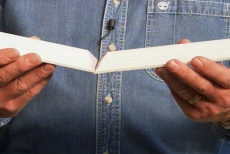
We apply the activator with a roller. Then fold the pasted sides together, a process called booking, leaving the pasted surfaces in contact with each other for a few minutes before application insures the adhesive is thoroughly moistened and ready to go.

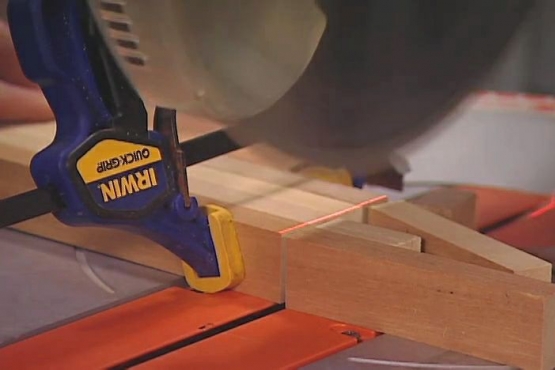
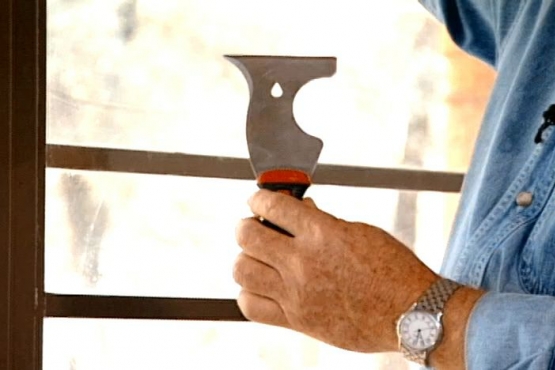
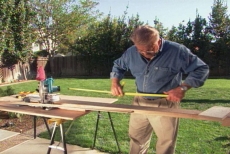
Strips are unfolded, positioned on the wall and pressed in place, using a wallpaper squeegee. Marcie trims the ends using a wide putty knife and a very sharp knife. Meanwhile, I step outside and start setting up the saw for the molding we'll soon be cutting. Now what I've done here is make a work support system for the power miter saw.

The reason is that we're going to be cutting several pieces of molding to exactly the same length and here's how it's going to work. First of all, let's say we want to cut a piece 42 inches long. I measure down from the blade, 42 inches right here.

And then take this piece of wood which I call a stop block, put it right on that mark, clamp it in place. And for my molding, I just simply set it on here, slide the end of the molding up against the stop block, then go ahead and make my cut.

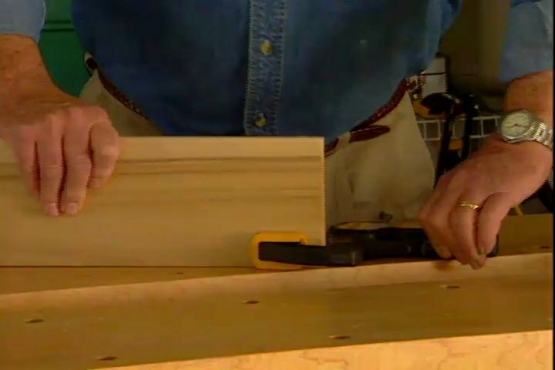
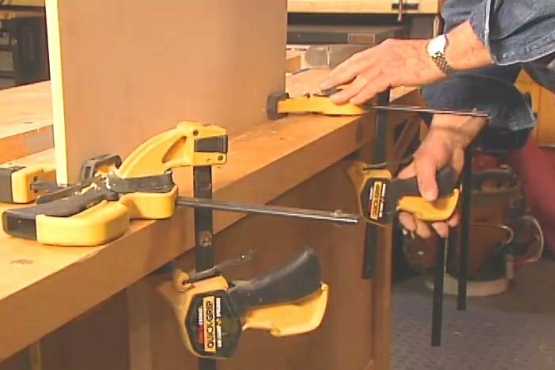
Before we start cutting in earnest though, we paint all of our molding. Pre-painting will save us a lot of tedious work later on.
[MUSIC]
Okay, guys, that's great. So these are all vertical pieces —
MARCIE NYSTROM:
Okay.
RON HAZELTON:
— cut. This is the chair rail. We're going to be putting this up next. It will have to have miters on the end too, where it goes to the inside corners. Maybe cut something like this. The — there will be one on each end, they'll got together like this and then give us a nice finished, inside look.

All the horizontal pieces of molding will be nailed into wall studs. Marcie locates and marks the studs, using an electronic stud finder.

Okay, now you see where the wall studs are. You — I'll tell you what, I'll put the first nail in right here, okay. Will you let me know when you're ready?

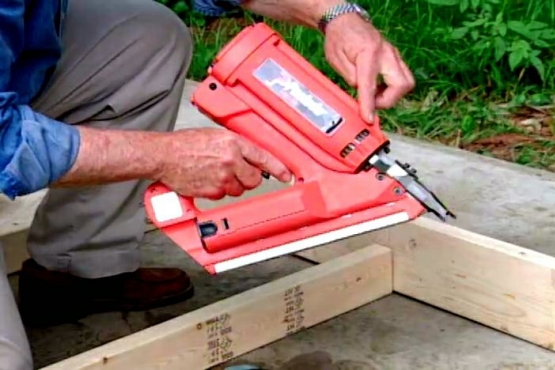
A pneumatic nail gun is by far the fastest and easiest way to attach molding and we don't have to worry about dents from a missed hammer blow. Air nailers can be rented or purchased. These days you can find an entire system for under 150 dollars.

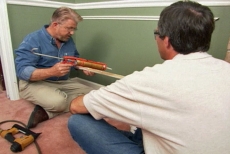
Now on this piece, we were able to catch three studs, John. On the verticals, there are no studs so we're going to have to rely on some construction adhesive here. So maybe you'd like to put just a dot every few inches on this.

We'll still nail these vertical pieces but just to keep them in place until the glue dries. The real holding power comes from the glue. Marcie wants a frame above the fireplace, in the center of which, she plans to hang a circular mirror. [NAIL GUN]

Now John, with these — our corner blocks or plinth blocks, we're going to set right here. The nice thing about these John, is that they —you don't have to cut any miters with these. We'll lay this in. Okay, John, so just drop this in here now.

With the molding up, we fill the nail holes with spackling, our fingertips seem to work best for this.

Fellas — why don't you stand down, John, and let me know if it's in the center here.

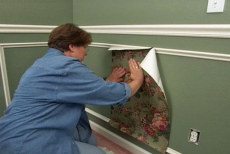
While John and I have been installing the molding, Marcie's been wallpapering the inside of the panels. She cuts the strips oversize and forces out any air bubbles with a squeegee, making sure the pattern matches, and then trims off the excess with a sharp knife.

Well, I gotta tell you, I think this adds a lot of dimension, a lot of detail, a lot of depth to this wall.
MARCIE NYSTROM:
I think so too. This is a project that I've thought about for a long time, but we would never have done it in this much detail by ourselves.
RON HAZELTON:
You know what I love about this project —with a few strips of molding and a little wallpaper, you can take a room from plain to fancy, contemporary to traditional. Whatever look or feel you want to create, it's just that simple.

Learn how to construct and wallpaper decorative molding frames.

Originally planned as wallpaper border and decorative frames installed over a freshly painted living room wall, this project gains an upgrade with the addition of chair rail molding and a mirror over the fireplace. A little paint, wallpaper, and trim dramatically change the appearance and character of the room, picking up the colors in the furniture.
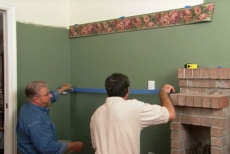
Lay out a Design Mock-up for the Decorative Wall Frames
Step 1

Lay out a Design Mock-up for the Decorative Wall Frames

Make a temporary panel mock-up for your decorating elements using masking tape to simulate chair rail and decorative wall frames and to get a feel for the best elevation. Tape up a strip of wall paper border for effect.
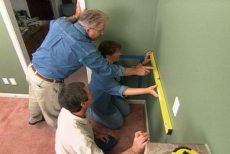
Mark Final Measurements and Layout for the Decorative Wall Frames
Step 2

Mark Final Measurements and Layout for the Decorative Wall Frames

Transfer measurements and positions for the decorative wall frames on the wall to guide actual installation. Remove the temporary tape and use a bar level to ensure lines are level and plumb for each panel.
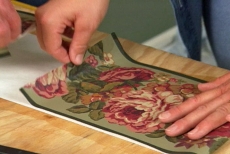
Prepare the Wallpaper Border for the Decorative Wall Frame Project
Step 3

Prepare the Wallpaper Border for the Decorative Wall Frame Project

Use a small paint roller and paint tray to apply paste activator to the wallpaper border to go above the decorative wall frames. Book the wallpaper, folding the pasted sides together for a few minutes to thoroughly moisten the adhesive.
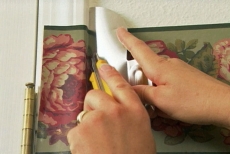
Apply the Borders above the Decorative Wall Frames
Step 4

Apply the Borders above the Decorative Wall Frames

Position borders at the appropriate pencil marks. Ensure the wallpaper pattern matches in each element of your decorative wall frames project. Press the border in place, removing air bubbles and wrinkles with a squeegee. Trim with a utility knife.
Make a Support System for the Decorative Wall Frame Trim
Step 5

Make a Support System for the Decorative Wall Frame Trim

Make a work support system with a stop block to hold the wooden trim/molding for the decorative wall frames and ensure that pieces are cut to exact length. Lay the molding across saw horses and paint it before cutting.
Cut the Decorative Wall Frame Trim and Chair Rail
Step 6

Cut the Decorative Wall Frame Trim and Chair Rail

Miter the ends of the decorative wall frame trim as required and cut the required lengths. Cut and miter the ends of the chair rail so that it fits together vertically on the inside corners of the room.
Glue and Nail the Decorative Wall Frame Trim in Position
Step 7

Glue and Nail the Decorative Wall Frame Trim in Position

Position and secure the horizontal decorative wall frame trim to the studs with a nail gun. Glue the vertical pieces with construction adhesive and drive in nails at opposing angles for additional support.
Measure for a Decorative Wall Frame above the Fireplace
Step 8

Measure for a Decorative Wall Frame above the Fireplace

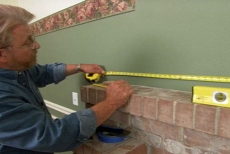
Measure dimensions for a decorative wall frame above the fireplace surround. Cut the trim and add attractive plinth blocks to eliminate the need to miter the corners. Hang a mirror in the center of the frame as a focal point for the room.
Fill the Nail Holes in the Decorative Wall Frame Trim
Step 9

Fill the Nail Holes in the Decorative Wall Frame Trim

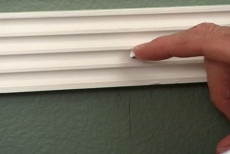
Fill nail holes in the decorative wall frame trim. Apply spackling compound with your finger if the trim is to be painted, and then touch up with paint. If the trim is stained, use wood putty in the correct color.
Add Wallpaper inside the Decorative Wall Frames
Step 10

Add Wallpaper inside the Decorative Wall Frames

Paste wallpaper inside the decorative wall frames and trim the overhang with a straightedge and utility knife. Remove air bubbles and wrinkles before the paper dries and ensure that the pattern matches in all wallpaper elements.

11Project Comments

We welcome your ideas and suggestions. Read through comments from other readers or leave your own.

The instruction aspect is good, but, good grief, is that not the most hideous wallpaper/green wall/white moulding.  Why not install classic wall panels, on a solid color?

avatar
Kendall
Apr 19, at 6:48am

please forgive my slightly negative comment.  I appreciated the information about how to do this as I didn’t know before I watched it so for that I thank you.  My problem was with the quality of the broken up videos, at least for me, I wasn’t able to get the end of the instruction in each one and it was a little annoying having to go through all the little snippets.  I would have liked a little more continuity with the videos.

avatar
marcia
Apr 1, at 7:08pm

This came at a perfect time for me because I have been trying to figure out how to do this. Now I know. I hope it turns out as good as yours did.

avatar
CeCe
Nov 7, at 7:54pm

I liked the wall panel look. However I did not like the white walls above the border. I think painting all of the walls with the green would have been a more unifying look for the room. Oh well as they say, different strokes for different folks.

avatar
Mike Cunningham
Nov 7, at 3:42pm

I see the walls have an orangepeel finish.  Don’t you need to sand that smooth before applying the wallpaper?

avatar
Sheri
Nov 7, at 1:29pm

Really like the look, moulding panels on the walls,Thinking of doing the same to one of my rooms. Thanks for the tips,Keep up the good work !!!!

avatar
P.L. Summitt
Nov 7, at 8:44am

They should have changed or painted the socket cover?! It draws your attention to just how ugly & utilitarian it is. Spoils the look.

avatar
Mary Rowlands
Nov 6, at 10:30pm

installing a mirror up high on a wall ,maybe you would like to tilt it down a bit .i did , that way you won,t see the light or fan. have anice day

avatar
Leo Szwiec
Nov 6, at 10:15am

Very nice change, Cathedral ceiling’d rooms are the worst feature of a house to deal with. If you are not comfortable with saws and nailers, the same effect can be acheived with shades of paint….admittedly some artistic talent is helpful. Enjoy for years to come!

avatar
Cory
Nov 6, at 7:43am

lol….miguel i suppose you never ever make mistakes in your life…
You know the camera man was told not to shoot the ladder below ron’s feet lol.

I’d get a new camera man!

But I too have been guilty of doing the same thing.. only i do it at 30 feet up.

This way i really get hurt bad…and won’t have to work for a few months or maybe the rest of my life…haha

avatar
Allen
Nov 6, at 5:10am

At the 5:16 time in the video both John and Ron are too high on stepladders.Many stepladders have a warning label that read “DO NOT STEP ABOVE THIS STEP” (or something like that) on the step second down. Get a tall enough ladder. I will visit you in the hospital!

avatar
Miguel Williams
Nov 6, at 1:36am

Submit A Comment

If you have a comment, question, or suggestion about this project, submit it here.

All Fields Are Required

Please enter the word you see in the image below: