How to Install Gutters

Video Transcript

Video Transcript

RON HAZELTON: Our first HouseCall today is in West Chester, Pennsylvania.  Now for Jim and Jeanine Breslin living in this 18th century farmhouse is a delight.  But it does have its share of problems, water for instance.

RON HAZELTON: Good Morning Folks

JEANINE: Hi Ron.

RON HAZELTON: How are ya?

JEANINE: Good.  How are you?

JIM:  Ron, How are you?  Pleasure to see you.

RON HAZELTON: Pleasure to meet you both.  What a beautiful house this is. This looks like an old farmhouse here.

JIM: The house was originally built in 1732.

RON HAZELTON: Really. 
JIM: And we moved in about a little over two years ago.

RON HAZELTON: Ah, it’s gorgeous

JIM: Yeah

RON HAZELTON: I understand that you’ve got a drainage problem

JIM: Yes.

RON HAZELTON: Now why don’t you show me what’s going on.

JIM: Sure, well, when we bought the house, the house did not have any gutters

RON HAZELTON: Jim quickly pointed out that the water just pours from the roof, creating among other things a rotted porch.  So our first task is to figure out the slope of the eaves which tells us where the water naturally flows.  This two-dollar item called a line level attaches to a string allowing us to create a level as long as we need it, in this case thirty-six feet.

RON HAZELTON: Let me know when it’s level now.
JEANINE: O.K., it looks level. 

RON HAZELTON: This is how much out of level, right here this distance, the roof is at this end compared to that end.  But we can use that to our advantage.

RON HAZELTON: A gutter attached to this long to this long portion of porch roof would be naturally sloped, carrying rainwater towards one end and eventually into a downspout.  All gutters must slope at least ¼ inch for every ten linear feet to provide proper drainage.  This section of the roof on the other hand is nearly level so we strike a level reference line, then a second mark ¼ of an inch below the line to indicate the correct slope.  This portion of the gutter will have a ninety-degree turn or an elbow on each end.  To determine the proper length for the straight section, we hold the elbows in place and then mark their ends.  For this mark we subtract ¼ inch to allow room for the seams that we’ll install later. 

RON HAZELTON: O.K. Jim put it on the ¼ inch mark there (PAUSE) alright and sixty-seven.

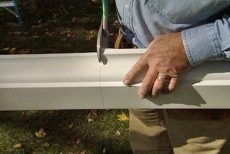
RON HAZELTON: Rain gutters are made of aluminum, copper, plastic even wood, but aluminum seems to be the most popular variety probably because it’s inexpensive and easy to install.  If you go out to by them you will usually find them in ten foot sections like this that are measured and cut to length and then hooked together with special connectors.  I’ll show you more about that in a second.  Right now, let’s cut this first section we had sixty-seven inches up there.  Take the tape measure, measure down from this end.  Make a mark at sixty-seven inches, then use a combination square to carry that line all the way around the gutter.  (PAUSE) Now, we’re ready to cut, heavy-duty tin snips are the best tool to use for this job and there is a technique.  Start at the top and cut down the face of the gutter first, then make the second cut down the back.  Finally, crease the gutter and make the third and final cut across the bottom.  Careful now, these are razor sharp edges.  We’ll use hanging brackets to attach the gutter to the edge of the eaves.  The manufacturer suggests placing brackets six inches for each end and then every eighteen to twenty-four inches.     
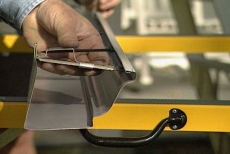
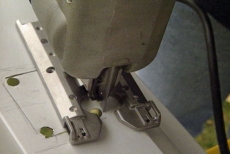
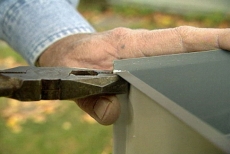
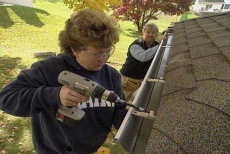
We then snap the brackets into place and head up to the roof.  To mount the gutters we’ll drive a screw through each bracket and into the faceboard on the eaves.  For the last section of gutter we’ll connect a downspout while Jeanine holds the gutter in place I mark the location of the downspout hole.  This sleeve will connect the downspout to the gutter.  Now to install it we have to cut a square hole in the bottom of the gutter, those are the lines that we just drew for position.  We can actually use this sleeve as a template, just lay it on top and trace the outline with a pencil.  In order to cut out the downspout opening we’ll first make a punch mark in each corner.  Then Jeanine will drill her starter holes and cut the opening using a jigsaw.  When she is finished I file the edges smooth.  Next, we apply a silicone sealant to the lip of this downspout connector, and place it into the cutout.  Now we’ll drop that right down into here.  Press it into place.  Jeanine secures the downspout connector with short sheet metal screws.  Since this will be the last gutter section in the rung, we’ll need to install an end cap.  The cap is slipped into place and the edges are crimped to hold it into place.  With the downspout sleeve into place, we’ll hang the gutter.  (DRILLING NOISE) With the gutter attached to the faceboard, Jeanine and I measure the length for our downspout. 

JIM: Seventy-five, o.k. good.

RON HAZELTON: Now the two ends on a piece of downspout may look the same but actually they’re not.  One end is tapered like this one so that it will slip into the end of the next section.  Now when you are cutting downspout always cut off the larger end, never cut off the taper, and when you are installing it make sure that the large end is up and the tapered end is down. Here’s why; if the large end faces down, water will leak through the joint, but if the large end faces up, water will flow past the joint without leaking.  It’s time to assemble the downspout and do a test fit.  UHOH, this is something that I hadn’t counted on.  The bottom is hitting the concrete down here.

JEANINE: O.K.

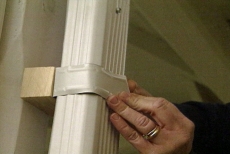
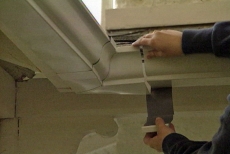
RON HAZELTON: The solution here is to cut some wooden spaces from two by four lumber.  Aluminum mounting straps are then screwed to the spacers and attached to the post with screws.  Now we can slip the downspout assembly over the connector and secure it in place with screws.  Then we fold the aluminum mounting straps around the downspouts and attach them with screws.  Our last step is to connect the straight sections of the gutter to each other and the corner angles using this two-inch strip of aluminum called a seamer.  It over laps the joints and fills in the ¼ inch gap we left earlier.  The joints are made watertight by applying a heavy bead of sealant on the inside.  Well, that should do it guys, let the sealer dry overnight and then tomorrow take a garden hose and put it in this end of the gutter, check to make sure the water is flowing this way and going into the downspout and that it’s not leaking at the joints.  And, you have got this gorgeous Maple tree right here unfortunately it’s going to dump a lot of leaves into these gutters so I’d put up some leaf guards all the way around especially on this end.  It was a pleasure working with you.   
JEANINE: It was great working with you.

RON HAZELTON: You were wonderful working with the hand tools.

JEANINE: Thanks a lot Ron

RON HAZELTON: Oh you’re very welcome.  Jim all the best to you.

JIM: Thank you

RON HAZELTON: And guys enjoy the gutters

JIM AND JEANINE: Thanks.

Learn how to install gutters correctly to protect your home from water damage

Learn how to install gutters correctly by measuring the slope of your eaves and adjusting the slope of the gutters accordingly for maximum efficiency.

gutter and downspouts
Step 1

gutter and downspouts

Using a line level attached to a string, figure out the slope of the eaves. All gutters must slope at least ¼ inch for every ten linear feet to provide proper drainage.
Measure and Mark for a Level Roof and for Elbows and Turns
Step 2

Measure and Mark for a Level Roof and for Elbows and Turns

For a roof that is level, strike a level reference line, then a second mark ¼ of an inch below the line to indicate the correct slope. If there are portions of the gutter which will have turns or elbows on each end, determine the length for the straight section by holding the elbows in place and marking their ends. Subtract ¼ inch to allow room for the seams that will be installed later.
Cut Gutter Sections to Size
Step 3

Cut Gutter Sections to Size

Mark the gutter sections using a combination square to carry the line all the way around, then use heavy-duty tin snips to cut the piece to length
Mount the Gutters
Step 4

Mount the Gutters

Snap brackets into place six inches from each end of the gutter and then every 18 to 24 inches. Mount the gutters by driving a screw through each bracket and into the face-board on the eaves.
Preparing for the Downspout
Step 5

Preparing for the Downspout

Holding the gutter in place, mark the location for the downspout hole. Cut a square hole in the bottom of the gutter by first making a punch mark in each corner and then using a jigsaw. File the edges smooth.
Install Downspout Connector and End Cap
Step 6

Install Downspout Connector and End Cap

Apply silicone sealant to the lip of the downspout connector and place it into the cutout. Press into place then secure with short metal screws. Install an end cap into the last gutter section but slipping it onto the end and crimping the edges.
Attach Gutter to Eaves, Cut and Fit Downspout
Step 7

Attach Gutter to Eaves, Cut and Fit Downspout

Attach the gutters to the eaves by driving screws through each bracket and into the face-board of the eaves. Cut and fit the downspout pieces together, making sure that the tapered end is down.
Using Wooden Spacers for the Downspout
Step 8

Using Wooden Spacers for the Downspout

If necessary, cut wooden spacers from two by four lumber and attach aluminum mounting straps, using screws and fastening both to the post. Install and screw downspout pieces together. Fold the aluminum mounting straps around the downspout and secure with screws.
Connecting Gutter Sections
Step 9

Connecting Gutter Sections

Connect the straight sections of the gutter to each other and the corner angles using a two-inch strip of aluminum called a “seamer”. It over laps the joints and fills in the ¼ inch gap left earlier. The joints are made watertight by applying a heavy bead of sealant on the inside.
Step 10

Testing the Gutters

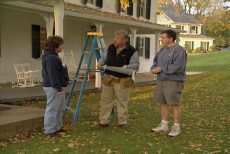
Let the sealer dry overnight, then take a garden hose and put it in the end away from the downspout and check to make sure the water is flowing toward and into the downspout and that it’s not leaking at the joints. If leaves are a problem, put up leaf guards all the way around.

17Project Comments

We welcome your ideas and suggestions. Read through comments from other readers or leave your own.

Your videos were very helpful in teaching me the basics about installing gutters and downspouts.  They are concise and easy to follow.  I had a blocked downspout where the water was spraying out one side of the downspout near the gutter.  When I took off the downspout I discovered that not only was it blocked with pine needles but that a 3” x 4 1/2”  piece of the downspout was connected to a 2” x 3” hole cut in the gutter.  A sealant had kept the piece connected for several years - a gift left by a company that enclosed my patio and reinstalled the guttering.

Now through your videos I can correct this problem either by cutting a hole to fit the downspout or see if there are elbow pieces with a 2” x 3” at one end and a 3” by 4” at the other.

avatar
Jan
May 14, at 7:04am

I have a medal roof which ends flush to the fascia (sp) board.
How and can I install gutters???

avatar
Shirley
Apr 30, at 10:35pm

Is a down spout from the second floor roof supposed to be emptying onto the middle of the first floor roof ?

avatar
nadia frangos
Jan 23, at 7:08pm

Great video. Should the drip line be in the middle of the gutter?

Thanks

avatar
Sammie W. Mize
Jan 9, at 2:15pm

I’ve priced the gutter at home improvement stores and if you are putting up more than just a 10’-30’ straight section, you’d be better off having a professional install seamless gutters. I’ve been installing gutters for over 20 years professionally and I’ve been paid many times to remove and dispose of seamed gutter systems. A professional installer would have only four seams to seal on this entire project. The two corners and the two end caps. The two corners, on gutters installed this way, had six seals and that doesn’t even count the seals every 10 feet. Also, a professional installer would have offset elbows to prevent the need to have wood blocks behind the downspout. Save yourself time, money and frustration. Have your gutters installed by a professional. My estimate professionally installed $199 for this job.

avatar
Dave
Jan 1, at 3:39pm

...why would you screw the downspout adapter from the inside of the gutter, instead of from the outside…this way you would not have screw threads visible from the outside of the gutter (I use pop rivets myself)

avatar
robert kimmerle
Dec 4, at 2:05am

Outstanding video and superb instructions! Thanks to this site, my daughter and I were able to replace a 10’ section of gutter that had fallen down due to a heavy snow storm we had a few years ago in northern Arizona (65” in Jan. ‘09). We installed new brackets every 16”, lining them up with the trusses.  For the sealer, we used Solar Seal 900. Thank goodness for 2 extension ladders and neither of us are afraid of heights. Thanks again for this step by step instructional video. You saved us a bundle of money & our gutters are just like new again.  smile

avatar
Laura
Nov 20, at 9:47pm

Could you come to Indiana before the snow come and install me some better gutters??  I’m willing to help you so I can learn??

THank You!!

avatar
M Alicea
Oct 15, at 6:24am

Great video,,this is by far the best I have seen,easy to follow(even for me) and wonderful detailed explaination.

Thank you

avatar
Shane Ali
Oct 13, at 2:44am

When attaching the gutters to the eaves (Step 7), should the hangers/brackets be screwed through the roofing drip edge or just under the drip edge? I am told that through the drip edge is preferred as it better prevents water from getting behind the gutters, but that doesn’t seem right to me.

avatar
K. Bobick
Oct 7, at 5:23pm

Great video! I found it to be very helpful. Thank You!

avatar
Scott
Oct 4, at 11:55am

Much more helpful than other videos. More detail, more closeup shots.

avatar
Howard Young
Oct 2, at 4:43pm

Hi how far from the drip edge should the gutter be ?

avatar
H Brooks
Sep 10, at 7:17am

what is the name of the tool used to cut holes in the aluminum? HELP ME!!!, I need to know what to ask for when i walk into home depot or my neighborhood ace store

avatar
kory james
Aug 29, at 1:58pm

are the edges suppose to connect, like on the corners, I saw they wernt on the video??????HELP, i need to know

avatar
kory james
Aug 29, at 1:57pm

More of a question:
Wonderful video….great detail ....
Unfortunately we bought a new/different style of eves-trough and the joints “between the 10ft straight sections” are not sealing properly and leak (especially not cool when its cold- ice volcanoes on the sidewalk)....we have tried to seal with 3 different types of sealant a few times and still no luck ....fear we will have to tear out new (er)  gutters and bring in the professional single piece eves. 

avatar
Janice
Aug 25, at 2:48am

Much more helpful than other videos. More detail, more closeup shots.

avatar
t kane
Aug 3, at 4:23pm

Submit A Comment

If you have a comment, question, or suggestion about this project, submit it here.

All Fields Are Required

Please enter the word you see in the image below: