Search all of RonHazelton.com:
[Log In]

How to Make a Concrete Countertop
Learn how to make a concrete countertop for your kitchen
Homeowners in this project have already used a variety of decorative concrete surfaces in their home, including a custom-made polished concrete countertop in the kitchen. They have also decided to use polished concrete again for a new countertop on their existing bathroom vanity, which is of ordinary construction without any special reinforcing. The craftsman demonstrates the steps to build a form/tray and pour the concrete surface. His product has a simple, durable, and non-absorbent finish with an old-world look. Home improvement enthusiasts should find the steps straightforward and the materials readily obtainable from home improvement stores.
Step by Step Instructions with Video
Step
1
Remove Sink, Hardware and Countertop
Prepare for your project by assembling tools and materials and removing the current sink, hardware, and countertop, if necessary. Virtually any vanity base of standard construction can accept the weight of a concrete countertop. Be sure to wear protective gloves and goggles, because mortar is caustic.
Step
2
Install Cleats
Install cleats on the four vertical sides of the sink cavity (the rectilinear opening in the top of the vanity) to make a ledge around its perimeter. The ledge will hold a temporary piece of particleboard to fill the hole flush with the vanity top. The combination of existing vanity top and particleboard will constitute the bottom of the form/tray you must build to hold the mortar until it hardens into the concrete countertop. (If your vanity is completely open at the top, you may need a slightly different approach to building the tray with a removable bottom around the sink.)
Step
3
Cut Melamine

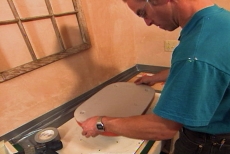
Measure and cut a piece of vinyl-coated particleboard called “melamine” to fit the sink cavity opening and drop it onto the cleats to serve as a bottom for the form. The melamine should be flush with any existing surface on the cabinet. Its vinyl-coated surface will not stick to the concrete. Later, after the concrete countertop has set and you have removed the ledgers, you can easily remove the ledgers and melamine.

Step
4
Drill Three holes
Drill three holes through the melamine for the sink taps and drain hardware. Determine the best diameter/size for these holes based on the diameter of the sink hardware.
Step
5
Insert PVC Pipe into Holes
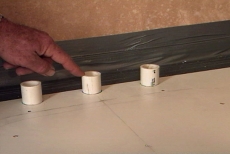
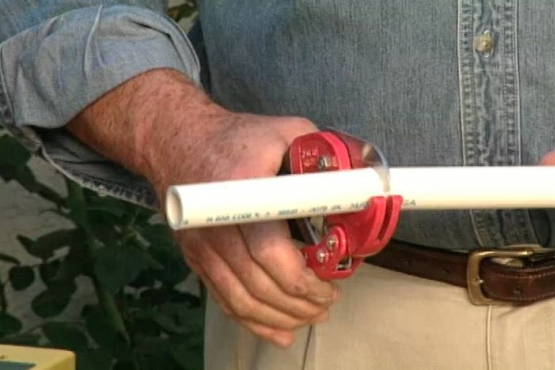
Insert three short pieces of polyvinylchloride (PVC) pipe to fit snugly into the holes. The PVC pipe will keep the holes open while you pour the concrete in a later step.
Step
6
Attach Two 2 x 4s

Attach two temporary two-by-fours at the upper edge of the vanity, setting them flush with the vanity’s upper horizontal surface and placing the screw holes as inconspicuously as possible. The two-by-fours will extend the bottom of the concrete form so that the countertop will have a decorative lip or overhang on completion. We wanted the overhang on the two exposed edges of the countertop only—so we taped (with electrician’s tape) the two edges that butt against the walls to seal the bottom of the form and protect the walls.

Step
7
Secure a Strip of Melamine

Secure a strip of melamine to each of the two-by-fours to form a 2 to 2 ½-inch wall for the concrete form. The top of this wall will mark the depth of the countertop, so ensure that the installed height of the melamine matches the desired depth of the finished countertop. If you make it too thick, the countertop surface will not be a standard elevation from the floor.

Step
8
Cover Wooden Surfaces with Electrician's Tape

Cover exposed wooden surfaces with electrician’s tape to ensure they will release easily from the concrete when you remove the form. The tape’s non-porous suface prevents sticking and lessens the likelihood of damage to the edges of the hardened concrete countertop.

Step
9
Cut a Styrofoam Block

Cut a Styrofoam block the same diameter and shape as the sink to make a barrier/dam to preserve the proper opening for the sink. Ensure that the vertical sides of the foam are slightly greater than the intended thickness of the concrete countertop to prevent the wet mortar from burying the Styrofoam block. Taping the edges with electrician’s tape will help prevent the concrete from sticking to the edge of the Styrofoam and give it a little support.

Step
10
Apply Caulking
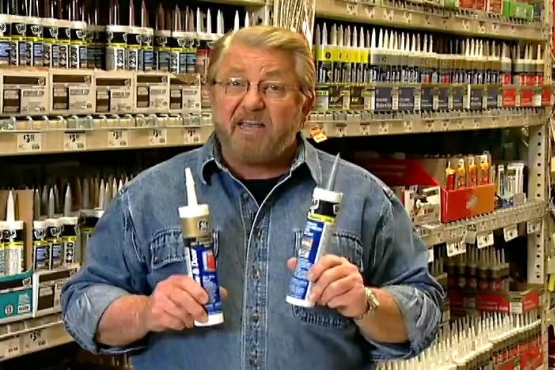
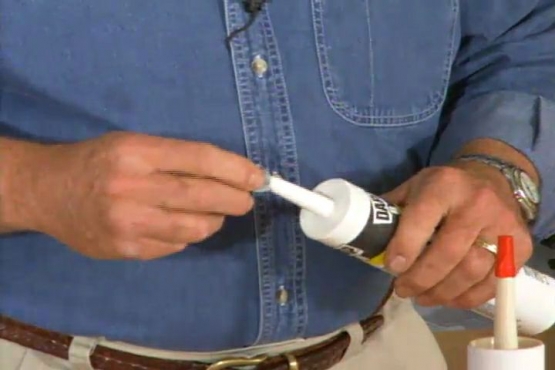
Apply a bead of caulking around the bottom of the Styrofoam shape to provide a good seal and position it on the top of the melamine surface. Water and drain piping will indicate the correct location.
Step
11
Secure Styrofoam Block
Secure the Styrofoam block to the melamine with screws and large washers to help stop the Styrofoam from breaking. Do not tighten the screws too much or you will damage the Styrofoam.
Step
12
Set Reinforcing Steel/Mesh in Place

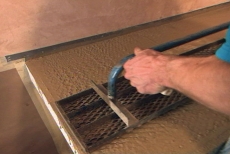
Set a piece of reinforcing steel/mesh (with a cutout for the sink and its hardware) in place to give the countertop additional strength and prevent cracking—in much the same way that rebar is placed in concrete pads when they are poured.

Step
13
Mix Concrete
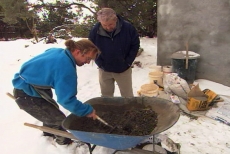
Mix the first of two batches of concrete in a clean wheelbarrow. The first batch will form the bottom core of the countertop and use a ready-made mix with pea-sized aggregate. Minimize the amount of water added to make the concrete mixture moist but not runny (you will be shoveling it into the form rather than tipping the wheelbarrow).
Step
14
Work Mortar to Crumbly Consistency

Work the mortar to a uniform crumbly consistency with a mason’s hoe and then roll the wheelbarrow into the bathroom after protecting the floors along the route.

Step
15
Shovel the Concrete into the Form
Shovel the concrete into the form, filling it halfway to the top with this type of concrete. Avoiding too much water in the mixing process enables you to control placement of each shovelful and will help avoid spillage in the interior of your home.
Step
16
Compress Concrete
Compress the concrete by pounding it with a wooden float. The agitation and pounding helps remove air bubbles and voids that weaken the concrete when it has hardened. Maximum strength comes from a uniform and solid consistency.
Step
17
Mix Another Batch of Mortar

Mix another batch of mortar, this time starting with quick-drying cement. Before beginning, hose the wheelbarrow and other tools to remove any coarse aggregate and residue. Allow the clean wheelbarrow and tools to dry, because you will be mixing a series of dry ingredients for this batch or mortar and do not want moisture to cause lumps before you have completed the "recipe".

Step
18
Add Various Additives

Add marble sand, white Portland cement, and mineral pigments—all are available from your home improvement store. Follow manufacturer’s directions in judging the quantity of these additives to give the countertop a finer, richer texture and color than the core layer of concrete you already poured. Blend the quick-drying cement and the additives thoroughly while they are dry.

Step
19
Add Black Slag
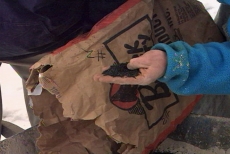
Add the black slag and mix it with the other dry ingredients. Much finer than the aggregate in the first layer of concrete, the slag is a recycled product with shiny glass-like particles of many different sizes. It will be visible as dark speckles in the finished surface of the countertop.
Step
20
Add Water and Mix

Add water to the dry ingredients and mix it to a uniform consistency with the mason’s hoe. The mixture should be just thick enough to hold its shape when you scoop out a shovelful.

Step
21
Shovel Mortar into the Form
Shovel this colored mortar into the form, packing it initially with the back of the shovel. Do not fill the form completely.
Step
22
Trowel Gaps Around Edges
Trowel gaps around the edges of the Styrofoam sink dam and along the perimeter of the form. Later, after you level the concrete and ensure that you have not overfilled the form, you will fill these gaps with thinned mortar.
Step
23
Level the Surface
Level the surface with a screed/straight edge so that the concrete is flush with the edge of the form. Drag the screed across the top edge of the form as a guide and remove any excess mortar without disturbing the gaps left earlier.
Step
24
Thin Remaining Mortar
Thin the remaining mortar slightly and pour it into the gaps around the sink dam and the perimeter of the form. The thinner mortar will help eliminate air bubbles and voids and make smoother edges.
Step
25
Tap with a Hammer
Tap with a hammer repeatedly along the outside perimeter of the wooden form to knock out any air bubbles from the edge. Any air bubbles that remain will weaken the concrete and possibly disfigure the formed edge of the countertop with very noticeable pits at the surface.
Step
26
Knock the Aggregate Deeper into the Countertop
Use a jitterbug concrete tamper to knock the aggregate deeper into the countertop and bring the fine particles, sometimes called cream or paste, to the top for a finer surface texture. If you rent a jitterbug, it may come equipped with a long handle that permits you to stand upright to use it. For this application, however, the long handles would be a nuisance, so remove them.
Step
27
Let the Concrete Set
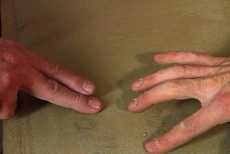
Let the concrete set for approximately an hour and then check to see whether or not it hard enough to trowel. If you can press gently and leave a slight fingerprint without lifting a little divot of mortar, it should be ready.
Step
28
Trowel the Concrete

Trowel the concrete to smooth out and burnish the surface. Use a flat hand trowel on the surface, being careful to hold it parallel to the surface. Pull it horizontally, alternately working in small arcs, to smooth any imperfections in the surface. Be careful not to tip the trowel or gouge its corners into the concrete—filing the sharp points off the corners of the trowel blade can help. Repeat this process several times while the concrete continues to set over the next few hours.

Step
29
Allow to Dry Overnight and Remove Form

Allow the concrete to dry overnight and remove the form—that includes the two-by-fours, melamine pieces, ledgers, and the Styrofoam sink dam.

Step
30
Sponge the Surface
Sponge the surface to clean off any haze and allow the concrete to cure before reinstalling sink and hardware or performing any additional procedures such as polishing or sealing the countertop.


Home | Contact Us | Advertising & Product Placement | Media Inquiries | Privacy | Terms of Use | Pages Index
2009 Ron Hazelton Productions - Do It Yourself Home Improvement - All Rights Reserved
Website Design by Jonathan Preston and Mark Godwin
Page generated in 0.458 seconds