RH: After enjoying the rapids of the MacKenzie river I’m heading to the town of Monmouth, Oregon to meet Jennifer Cook who is having a problem with her back yard deck. The wood is showing signs of dry rot and I suspect it’s time to replace the entire surface. While Jennifer’s husband, David, is at work she and I are going to tackle the job. A very nice day. Look good, nice sun here. Well located. All right. It looks like this has been down a while. Any idea how old it is?
JC: It’s about 15 years old.
RH: Okay. Well, that’s, you know, that’s not a bad life for a deck up here in this climate where it’s kind of moist.
JC: We get a lot of rain.
RH: You get a lot of rain. You know, I think that there’s no question. We’re going to have to pull these boards up and replace them but I’d like to do a couple of things differently this time. You see this line right down through here? I’d like to stagger these joints. Make the deck look more like one deck instead of two halves put together.
JC: Okay.
RH: Secondly, you see over here where the boards are rotted on the end? To prevent that from happening I’d like to treat the ends of the boards that we cut with a preservative that’ll keep them from rotting out that way. Then also I’m thinking that, you know, maybe we just eliminate all these nail heads entirely here by using an invisible fastening system here.
JC: That would look a lot nicer.
RH: It would avoid things like this too, where these nails are popping up. So, why don’t we begin by taking these boards up.
JC: Okay. Let’s get started.
RH: Jennifer and I start out using pry bars to remove the facia or edge boards that run around the deck. Okay. You should be able to grab this now. Okay. Hold it. Great. There we go. Jennifer, I want to pull some of these nails out of this first plank here. We then tackled the rest of the planks. To do that I’m going to use this tool.
JC: I’ve never seen one of these before.
RH: This is a nail puller. You haven’t?
JC: No.
RH: It’s actually a Japanese hand tool. It’s really great. Here’s the way you use it. Put the tips of this tool right here. Those two sharp points right at the edge of the nail head, like that. Okay. Then take your hammer, there’s a striking surface right here, and the idea is to drive this up underneath the head of the nail. All right? Now, we’re going to pull this back like this. All the way. There you go. One thing that will help when you get to this point . . . put a block of wood in here . . . All right. Great. Okay now pry it up. It’s not necessary to pull out all the nails. Jennifer and I can use pry bars to lift the board the rest of the way. Lift. Stand by. Lift. Okay, all the way up now.
JC: Can you give me a hand with this Ron?
RH: Sure. Okay.
JC: Are you ready?
RH: Yeah. Okay there we go. Very nice. Once we remove all the old deck beams we inspect the remaining joists for dry rot. You know I want to check these joists here to make sure that there wasn’t any dry rot. One easy way to do this is to take a screwdriver like the one that you’ve got there and just kind of poke the top of these any place that looks a little suspect. These seem to be all in great shape so that’s good news.
JC: Yeah, they look good.
RH: We don’t have to replace any of those.
JC: Definitely good news.
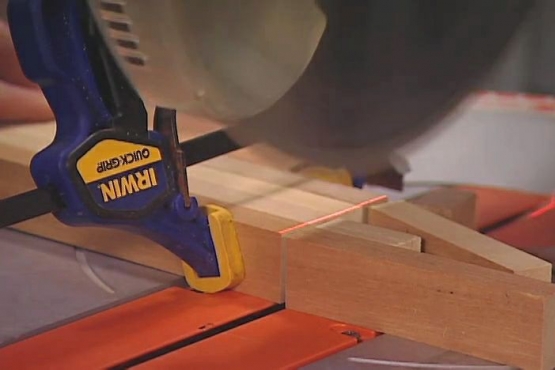
RH: When laying out a deck it is best to avoid having joints and straight lines. A staggered pattern is more pleasing to the eye. To get this patter we’ll first lay down a full board. Let’s call it board #1. From Board #2 we’ll cut a section long enough to finish the first row. Then we’ll start the next row with the remainder of board #2. We’ll finish out this row with a portion of board #3, start the next row with the remainder of that board and so on. The plank ends must meet at the center of a joist so that they can be supported and attached. Slide this all the way out. After a quick lesson on using the power miter saw Jennifer gets to work. I asked to Jennifer to wear a mask as she cuts because this wood is pressure treated to resist rot and it’s possible for the sawdust to cause an allergic reaction. Now that is a very nice clean cut for your first time.
JC: Yeah. It’s awesome.
RH: Jennifer and I set the first board in place.
JC: All right, this needs to come down this way some.
RH: Okay. Good. We nail the board down to the joist. Now this first board and the last board are the only ones we’re going to nail from the top. The rest will be secured with an invisible fastening system. Now this is the system that we’re going to use to attach these deck boards. These are called deck board ties. They get nailed to the edge of each board and these tabs right here slip up underneath the adjacent board just like this. Then the other edge of this board gets toenailed. We continue that process as we work our way across the deck. Now, there are three advantages to these. First of all you don’t have any visible nail heads or screw heads, no rust marks and no dents from missed hammer blows. Okay, Jennifer. Yeah. Mark that last one if you would. We have a lot of boards to attach. The technique is the same for each. Jennifer marks where the deck board ties need to be placed. She then nails the tie to the board and slides the board into position. Slide it under. Along the opposite edge of the plank nails are driven into the joist at an angle. That’s called toenailing. While we’re attaching the boards Jennifer applies wood preservative to the freshly cut ends. This will help prevent the dry rot we saw in the old deck. We’ve made some good progress and have about half the boards in place when we decide to break for the day. You know, we couldn’t have times our second visit better. We’re going to finish the deck on a really special day for Jennifer and her husband David. Good morning.
JC: Good morning Ron.
RH: How you doing?
JC: Good. Are we ready to get started again today?
RH: I’m ready.
JC: All right let’s go.
RH: Got your hammer?
JC: I do. Let’s go.
RH: Jennifer and I pick up where we left off, continuing to install the new deck boards using the invisible fasteners until finally . . . last board. And we’re ready for the next step. Now it’s time to cut the ends of the deck boards to an even length. We snap a chalk line. Very nice.
JC: That’s an awesome line.
RH: Which Jennifer will then use as a guide . . . Brilliant, huh? . . . as she cuts the boards with the circular saw. We’re down to our last important step. We need to apply a sealer to the wood to protect the deck from the elements and extend it’s life. You really want to saturate the wood pretty good. Just like this back and forth, back and forth. You see I’m holding this maybe, I don’t know, a foot or so from the wood. A garden sprayer is a quick way to get the sealer on the surface. This sealer is milky when it goes on but will dry clear. After a few minutes, Jennifer, using a long handled brush works the sealer into the wood surface. Now all we have to do is let things dry. I think the deck turned out just great. And as I said before this is a very special day for Jennifer and her husband David who just got home. This is their fourth wedding anniversary. So, I’m going to surprise them with the deck and a cake. Hey guys, come on out. David, here’s your new deck. Well what do you think, huh?
JC: Wow.
DC: Wow. It looks great.
RH: Happy deck and happy anniversary. Can I pour you some champagne.
DC: Thank you Ron.
JC: You didn’t have to do that Ron.
RH: Well, it’s my pleasure. Congratulations guys. Four great years and many more to come to you. I hope you can spend a lot of them right out here relaxing on this deck, soaking up the sun.
JC: Well, we will in the summertime.
RH: You will.
JC: Mmm hmm.
RH: Okay, and I’ll be thinking of you.
JC: Okay.
RH: Can I cut you some cake?
JC: That’d be great.
RH: All right. You bet.
JC: Cheers.
RH: Jennifer definitely earned a glass of champagne after all of her hard work. As for me, ahhh, it was a piece of cake.