If you have an existng screened in porch or patio, you may be surprised by how simple it is to convert this space into a four season room that can be used all year round, no matter what the weather outside. The framework is already there, all you need are some walls and windows, and you've got a more livable square footage.
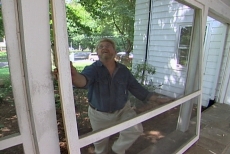
Begin by pulling away the molding or stops that hold the old screen panels into place. Once these have been removed, the panels should be easily tapped out of the frame with a hammer. If there is any additional trim on the exterior of the posts that will serve as your framework, you should also use a pry bar and a hammer to remove it during this step.
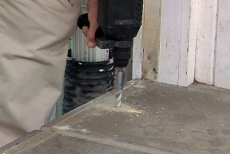
Before you build the walls, you will need to install a bottom plate. This plate consists of two boards, one on top of the other, that are bolted directly into the concrete pad below. This step ensures the stability of the walls as the room is finished. The bottom plate should be treated lumber, as it will be the most exposed piece to the elements. Install anchor bolts into the concrete so that the plate can be bolted tightly to the floor. You may also want to place a thin piece of foam insulation between the concrete pad and the bottom board, to make sure that it is weather tight.
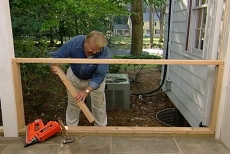
When framing the walls, you will need to make a plan according to the size of the windows that you've purchased. The walls should then be framed to the appropriate height for the windows to fit. Begin by nailing vertical 2 x 4's to the existng posts, and then nail a top plate across them. Once that plate is in place, then additional studs can be nailed into place, 16 inches apart. Nail through the plate into the top of the stud, and then toenail the bottom of the stud into the bottom plate.

Once the walls are framed, you will need to apply the exterior sheeting. An exterior grade plywood is perfect for this application. Simply cut the sheets to the proper size and nail them into place. You may find it helpful to build a simple square and to make a pencil mark along the straight edge. This will help you ensure that all of your nails are going directly into the heart of the stud, and not shooting around the sides. Once the sheeting is installed, then you should notice that the walls have become much more rigid.
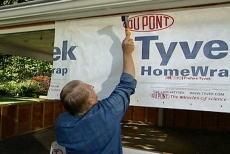
Housewrap will help weather proof the new room that you are building. It will act as a barrier to both moisture and wind, and will keep the wood framing and sheeting from rotting. Tyvek is a popular product often used for this application. Always make sure that the top piece overlaps the bottom, so that water always flows away from inside of the wrap. This will keep moisture away from the wooden framing of your four season room.
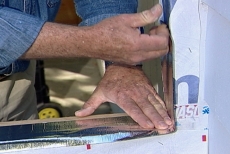
Before you install the windows and doors to your new four season room, you will need to make sure that the bare and exposed wood around the frames and jambs is sealed. Use a foil backed tape to do this. Overlap the sills and corners about 8 inches up the vertical sides and fold down the flaps. Think of it as gift wrapping the 2 x 4's that make up the frame.
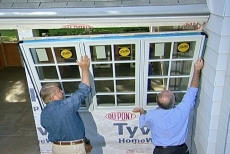
Once the frames are sealed with foil tape, you are ready to install the doors and windows. Begin by unfolding the nailing flanges and applying a bead of silicone to the inside of the flange. As you set the window into place, put the bottom onto the sill first, and then tip the top of the unit into place. Have a friend help you hold it in while you install the nails through the flange and into the framework of the wall.
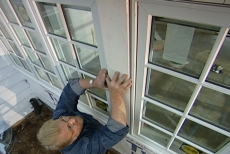
Now that your windows and doors are in place, you are ready to install the exterior trim. The trim design that you choose will be particular to your house, but for any project, you will need to install trim around the windows with a drip edge. This ensures that the water doesn't flow back under the sill and into your wall. 1 x 6 is also commonly used to fill the spaces between windows. It can easily be ripped on a table saw to fit whatever space you may need to fill. Cornice pieces can also be installed between the exterior wall and the eave to dress up the appearance of your new four season room.
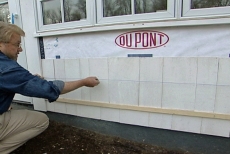
Whatever product you choose to utilize for your exterior walls, it is important that it is level. In this case, Ron is using a cedar shake shingles, and after using a thin strip of wood to ensure that they first row is lined up correctly, he snaps a chalk line after each successive course to ensure that the spacing is uniform all the way up.
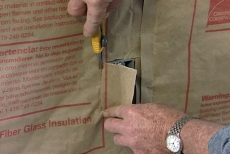
Use paper backed fiberglass insulation to insulate the walls. The bats of insulation can be cut to the proper length before you install them. Set the bats into place, unfold the paper tabs over the studs, and use a staple gun to fasten the tabs to the studs. The paper acts as a vapor barrier, so always make sure that it is installed facing the interior of the room that you are insulating. A utility knife can be used to cut around any electrical outlets or light switches that you may have chosen to install.
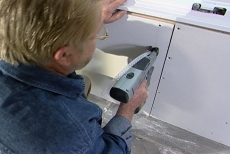
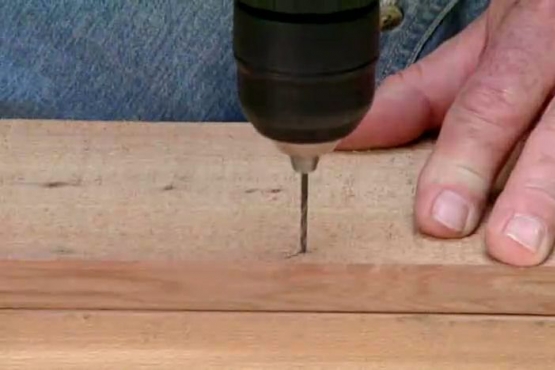
Begin this step by cutting the wallboard to the proper size. Try to utilize as many factory cut edges as you can, as this will make the finishing process a little easier. Screw the pieces into place using a screw gun. Ron is using a drill designed just for this process and it allows him to install the screws very quickly.
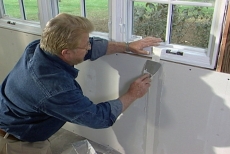
Begin the finishing process by filling the screw holes with joint compound. This may take several coats, with a light sanding job in between. The seams will require drywall tape to finish correctly. Coat the seam with joint compound, and then press the tape into the seam with a putty knife, pressing out any excess compound. It usually takes 2 or 3 coats to completely finish the seam, using a wider knife for each coat.
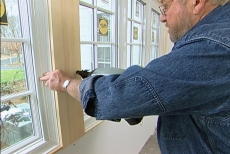
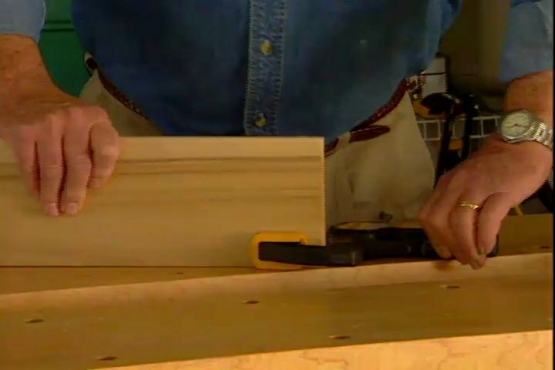
The final step is to apply the interior trim. This job is done quickly and easily with a cordless nailer that doesn't require a compressor. You can choose trim that matches the rest of the woodwork in your home, or give your new four season room a look and feel that is completely unique.
We welcome your ideas and suggestions. Read through comments from other readers or leave your own.
I am thinking of inclosing my backyard porch…i have my main electrical panel and electrical meter on this wall, under the porch roof. In the old days meter readers had to get into the yard and up to the meter to read it, then it went to pulling up in the alley and using binoculars to read the meter from their vehicle, now they are using a “gun” that im sure is some sort of infra-red device that reads the meters….my question is can i inclose my porch with the meter winding up in the inclosed area? will putting a window in front of the meter so it can be read thru the glass be ok? or can i even do this? i hope you respond quickly as this is about to happen asap…
I’m very impressed with the simplicity of your step by step instructions on an all season room. I feel confident now that this is a project my husband and I can do ourselves. Thank you so much! Happy Building!
The Browns
Just wondering what the ballpark cost would be for this project. Thanks.
just what an wonderful web page. The information helps myself with my preliminary research. I am attending school and I have a school assignment to create. I was intending to get custom research papers on the web, luckily your site has assisted me cope with authors hinder and i also feel like I am able to proceed on my own. Many thanks all for this great material.
the words used by “the Master” were uncalled for and offensive. I applaud the fact that you allowed the post which illustrates your honesty. keep up the good work i enjoy your site the most God bless you and to the “Master” get a life and go to church.
from chicago
I enjoyed this. It showed me what I needed. Can you do a video for vinyl siding? I have a screen room that is wood and I want to cover it with vinyl siding. Thanks for the different suugestions. I wake up at 5:30 on Saturday just to see your show.
Maybe someone else asked this question, but I did not see it. How did you get heat into the new room? I assume the porch did not have heat ducts yet in order to make the room as cozy as you said, when the outside is 20 degrees, you need to have heat brought into the room.
Great job, being a retired building inspector, but most codes require 6” walls, insulated all around,
foundation check, and permits. Things like this should be talked about.
I enjoy your site pike up many hints, I say Thanks
nice job, here in England we would have to have building reg’s very step of the way!!..then again.. must of our lower walls are made from brick.
love the video’s good health to ya.
regards
Rich.
Our closed in sunroom is above grade, and is located on a lake, what method should be used to insulate the floor ? Right now there is onlly the floor joists exposed to the weather. I need to know what insulation to use in the joist areas and how to cover the joist area to keep it from being effected by the moisture at the lake.
Thank you in advance,
Jim Dawsomspecial9
Ron, I have worked in sunroom construction in communities where code enforcement has forced contractors to go back and establish full foundations becaue a slab will support screens, but when you add the weight of framing and glass the rooms start sinking into the ground. Just a word of caution, not all porches are easily convertied to full time living space.
Ron instead of sanding the compound I found a damp sponge wiped over it before it completly dries is better than sanding and the dust.
Hi Ron,
Great job on your porch. You went into great detail about all the basics of the project. I wish we had more shows on TV and articals on the web about home projects. I have seen this project on your TV show and I have also seen how you did your heating for this project.
I also have sent you some project tips and have had your staff reply to my comments, So my thoughts are please keep up the great job you are doing, We need more people like you. Please over look the people with the bad thoughts about you and your shows. I thank you and your show are just what people need to see. I watch your show every saterday at 5:30am on TV.
Take care.
Ronnie Hogan
Nice finished room. The only comment I would add to your article/video is a note about permits. Where I live inspections are required for the framing, housewrap, wiring, insulation, and sheetrock of this project. Also would require 2 permits, one building permit for the entire project and one electrical permit to change/add a circuit.
As always, you explain everything in an easy to understand manner. I have always wanted to enclose my balcony/porch off of my bedroom without loosing the great summer time breezes. I have really enjoyed your videos, I just wish I didn’t have so many health problems, so I could do more of the DIY projects you always seem to make look easy. The best part is when I get someone to help me with the projects, I seem to know more than they do about the A-Z solutions and quick steps. Thanks for all you do, I love your TV show and I love this site even more.
Ron WTF !??! I, been sending in comments and none are being posted !! So now that your web site has totally pissed me off WTF ?
I have also written several times to you on your contact page over the last 18 months, and nobody has had the decency to reply !!
Again WTF ??? Please get your head out of your A___
Thank you Ron ! I’m awaiting heating and cooling suggestions.
Your videos are indeed informative…
your sun room is absolutely beautiful!!i love to watch your videos,you are so talented.what a great job,and you made it look so easy too.
Hermoso proyecto Ron. Se ve tan fácil cuando lo haces. Me gusta mucho ver la variedad de herramientas que usas, como te simplifican el trabajo.
¡Gracias!
Thanks, this is Going to be My spring project. The finishing on outsie was what I was wodering about.
good video as a construction guide! thanks….being a carpenter i want to know where you get the clothes that repel all forms of dirt!!
Ron
II noticed in this project you used a battery operated nail gun I have never
seen one please tell me how many volts and where can it be bought
What did you do about heating & air conditioning ?
How can it be cozy? Isn’t the floor really cold and what about ceiling insulation.
Otherwise I love your articles and they are easy to follow.
You should not squeeze the insulation over the wiring. It should be slit so all the cavity will be filled around the wire.
I was curious about what you did with the interior ceiling.
That was a good one & you made it look so easy. I know for a fact that it was not as easy as you made it out to be.
Love your tips
I understand all you did in the video. However I have a 1200 ft deck that has no exterior walls. I would like to close a nice size room on a portion of the west facing deck for a four seasons room. The deck has 2x12s has floor supports with 4X4 posts supporting the floor joists. Should I tale the 5/4 decking to start the framing or just use all the decking as support with marine plywood as a new base. The 5/4 decking was installed with the crown down and it catches water and snow and is starting to warp up on the sides of the boards. Thats why I’m rather reluctant to cover the decking with the plywood. Our Farm house was built in the early 1900’s and we remodeled thru the years with new interiors, plumbing, wiring, steel roofing and lots more. I want to be sure we do this project right to last for years to come. Thank yhou for any advice you have time to offer.
Jon & Joan Fricker
Ron, this was just beautiful, it shows me what is needed when I hire someone to do this job or me. Let me ask, what do I do now for the ceiling, it is aluminium, without insulation? Also, i wish to put “warmboard in the cement floor as my source of heat. I face North, and it is cold. My porch does have a cantina beneath it, it is unheated, but it is 7 or 8 feet high. Does this affect what kind of heating I should place in this new beautiful space? Also, I have seen these windows that are bifolding so that this room can still be open in the summer if required, is this unwise? I live in zone 6. I would love to get your insights on this, my sweet husband now plays guitar and his music carries from the basement, if this room becomes his music room it will be better for all.
Also, John Hammel’s comment “How did you insulate the ceiling? I’m doing the same thing with my screened porch and have it complete except for the insulation. I now have a nice vinyl ceiling with about 7” above it which is vented under the soffit and has a roof vent. I’d like to use syrofoam but fear cutting it and wonder what my options may be. HELP?”, is pertinent to my porch ceiling, what do i do re this?
Thank you kind sir, all the videos were fantastic!
Tracy
i have a deck with regular deck boards in good shape..it has a regular asphalt roof over it with a cathedral ceiling. before i put in the sill plates should i remove all the railing? also what type of flooring should i install, i will be carpeting. the deck is 3 ft off the ground with lattice, should i wait to install good osb to enclose it and insulate under the floor first? and what type of insulation under the floor should i use?
you are the first sensible person out there. i am lucky to have a deck 3 ft of the ground with regular deck boards. there is also a full cathedral ceiling and an asphalt roof over it. the whole house had new shingles last year. 3 questions. there are posts and railings around the deck. do i remove all the railing and then put down outdoor base flooring. (i plan on carpeting.) before i put down the sill plate? also there is only lattice at the bottom which goes into dirt. so should i use good treated osb to enclose that area? at what point and how should i insulate under the floor? and what should be used? i am planning on heating the room so i already have very good windows/door and know to insulate the walls. all of what i know i have learned from your show. i have watched it for years. thank you
Ron, this was just beautiful, it shows me what is needed when I hire someone to do this job or me. Let me ask, what do I do now for the ceiling, it is aluminium, without insulation? Also, i wish to put “warmboard in the cement floor as my source of heat. I face North, and it is cold. My porch does have a cantina beneath it, it is unheated, but it is 7 or 8 feet high. Does this affect what kind of heating I should place in this new beautiful space? Also, I have seen these windows that are bifolding so that this room can still be open in the summer if required, is this unwise? I live in zone 6.
I would love to get your insights on this, my sweet husband now plays guitar and his music carries from the basement, if this room becomes his music room it will be better for all.
Thank you, Tracy.
Well Ron I guess you have this section of your website for show because you obviously don’t take the time to read these comments. Maybe your just too busy now to deal with genuine queries for free!
Wow, this is in every respect what I neeedd to know.
We have had a 4 season room (we call it a breezeway) installed for several years, but our problem exists that we still have an exterior door and jamb installed between the house and breezeway and we would like to convert that exterior door and jamb to an interior door with no threshhold to step or trip over. The wall, what used to be an exterior wall, dividing the house and breezeway, is 6 inches thick. From what I have been able to find, most interior door jambs only span 4 inches. I could really use some input if possible. Thanks, Karen
Hi Ron I live in an older home, about 80 years old, and the front and rear porches are part of the house. I would like to do something similar to what you have done here to block the traffic noise from the road out front and to have a four seasons room off the kitchen in the rear. Do you have a process or instructions you could share with me? I can send photos if that would help!
Thank you in advance
Sue
How did you insulate the ceiling? I’m doing the same thing with my screened porch and have it complete except for the insulation. I now have a nice vinyl ceiling with about 7” above it which is vented under the soffit and has a roof vent. I’d like to use syrofoam but fear cutting it and wonder what my options may be. HELP?
Thanks much!
Wouldn’t you need to add heat? It gets cold in New England in winter.
If you have a comment, question, or suggestion about this project, submit it here.
All Fields Are Required
This has to be the best “how to” video I’ve seen for doing any construction work on your house. It was absolutely great. I feel confident I can tackle this project soon. I would like to know if you can add the estimated cost of the project somewhere on the website. Also would changing a carport to an enclosed garage be similar? Looking forward to seeing more great things from this site.