RON HAZELTON:
In a heavy rainstorm, it's the gutters' job to collect and divert water away from the house. 2 inches of rain on a typical roof can send a thousand gallons of water gushing the gutters and downspouts. Unfortunately gutters also seem to be a magnet for falling leaves and debris. And that debris can thoroughly clog gutters leaving the water no place to go except over the sides.
And as I found out, a lot of water spilling over my gutters and collecting below can cause real problems. In my case, the cascading water filled my basement window wells, breaking the window glass. The result: a flooded basement, soaked carpeting and a real mess to clean up.
Now I found out the hard way the kind of damage clogged gutters can cause. But there were some clues even before my basement flooded that a problem was developing. Now here's a telltale sign that I've got a clogged gutter.
And I don't even have to go out in the rain to see it. What's happening is the gutter is overflowing right up here. The water's coming down hitting the ground and then splashing all this dirt and mulch up on the side of the house.
So to find the source of this, all I've got to do is look up. You see that debris on the side of the gutter and those streaks coming down? Those are water marks. All evidence that that gutter is not working properly. Gutter cleaning is pretty low tech.
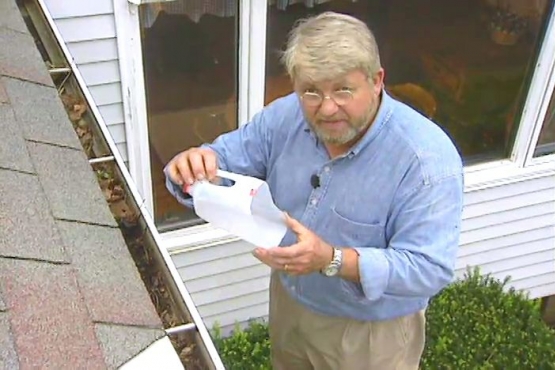
But this simple plastic scoop really does make it easier to remove leaves and twigs. The narrow profile fits all the way to the bottom. And pinching the top together gives me a grip on the debris as I'm removing it. Once the gutter is free of leaves, I use a garden hose to flush out the downspouts.
With the heavy material gone, this gutter washer will remove any remaining bits and pieces. The extension handle allows me to do some of this work from the ground without the need for a ladder. Well my gutter is clean and the downspout is clear.
That's the good news. The bad news is, I'm going to be putting a whole lot of water right up here next to my foundation and that's never a good idea. So what I want to do now is add something to the end of that downspout that will carry the water well away from the house.
A splash block like this, made of plastic or concrete, will carry downspout drainage a short distance from the foundation. Its main advantage is simple installation. This downspout extension replaces the bottom elbow. It's held on with a screw and includes a holding bracket.
When it's time to mow the lawn or get the extension out of the way, it just folds up and snaps into place. My downspouts are clear and I'd like to keep them that way. There are 2 important things I need to do. First put some kind of a strainer in the top of the downspout. This is a wire mesh type.
This drainer because it drains from the bottom may be less subject to clogging. Now I know the best way to keep my gutters clean is to prevent debris from getting in there in the first place. Gutter guards are one option.
They come in metal and plastic varieties. And they're available at any home improvement center. Quite honestly I found these a little tricky to install. And if wet leaves were to collect on top, well it could restrict the flow of water.
So I'm going to check out another option. I've come across a product called Gutter Cap. Here on the company's website I get an idea of how it works. The cap completely covers the gutter, keeping leaves and debris out. Surface tension though causes water to flow over the cap lip and into the gutter.
I've gotten the materials I'll need for the project but since the company nearly always provides installation services for this product I decided to have the pros put it on. Art Plakowsky starts by loosening the second row of shingles.
Then he slips a metal edge underneath. And secures it with screws. While Art's doing that, Ivan Ramonifac begins bending the cap sections to match the pitch of the roof. The bending complete, Art slips the cap into the metal edge.
Snaps it onto the front rim of the gutter and then screws it in place. In just a few weeks, old man winter will arrive. And since I've had real problems in the past with icicles and ice damming, I've decided to add an additional feature to my gutter covers.
A heater to melt the ice. An electrical heating cable is laid on top of the cap and concealed under a metal cover. Once it's in place, an end plate is cut to shape, set in position - and secured. Next, electrician Craig Zubka bores a hole through the outside wall and mounts a thermostat.
Then he uncovers the circuit breaker box, knocks out a hole in the bottom, installs a section of conduit and runs the wiring through to the outside. Craig then bores a hole near the bottom of the downspout, pulls the heating cable out and slips on a piece of flexible conduit.
Finally he connects the conduit to the thermostat and sets the cover in place. Back inside he installs the circuit breaker and puts the cover back on the breaker box. I test the gutter caps and they seem to be working just like they're supposed to.
This - this and this should be a thing of the past for me. As far as I'm concerned, let it pour.