How to Paint Kitchen Cabinets

Video Transcript

Video Transcript

R. HAZELTON:  We found our way to Lebanon, Ohio, about halfway between Cincinnati and Dayton.  Now, the first thing you notice here abouts are the lot sizes.  It seems that in this part of Ohio, people like their lawns big.

SABRE HILL:  Hi.

R. HAZELTON:  Sabre, how are you?

SABRE HILL:  Good.

SCOTT HILL:  Ron, welcome to Lebanon, Ohio.

R. HAZELTON:  Scott, well it's a pleasure to be here.

SABRE HILL:  Hi, come on in.  My kitchen is waiting for you.

R. HAZELTON:  Okay.  Let's take a look.
 
SABRE HILL:  This is the kitchen.  We're just finishing up our remodeling, and I'm finding this is just way too dark, with all the light things that I'm trying to do in the kitchen.

R. HAZELTON:  Yeah.  Why not just take these out and replace them?

SABRE HILL:  Cost is a factor at this point.  We want something just for the couple of years, until we can really remodel.

R. HAZELTON:  Okay.  So this is an interim thing.

SABRE HILL:  Right.

SCOTT HILL:  Right, just a temporary.

R. HAZELTON:  So what I'm going to suggest is let's paint these.  Put on some new hardware.

SABRE HILL:  Great.

R. HAZELTON:  They're going to look like new, but it will cost you practically nothing.
 
SABRE HILL:  I think that's a good plan.

R. HAZELTON:  Okay?

SCOTT HILL:  Sounds good.

R. HAZELTON:  Let's do it.

SABRE HILL:  Thank you.

R. HAZELTON:  Okay.  Guys, we're going to have to clean these cabinets off.  This is a heavy duty cleaner, sort of a TSP-like cleaner, although this is phosphate free.  Put some of that, about a quarter of a cup, in two gallons of warm water.  So we start washing.

SABRE HILL:  You missed a spot.

SCOTT HILL:  Did I miss a spot?  You're always telling me I miss spots.

R. HAZELTON:  We pay special attention to the areas around the stove, where grease and cooking oils are most likely to be present.  We're going to take these doors down to refinish them.  So I want to, first let's take off the knobs and then the hinges.  Are you set?

SCOTT HILL:  All set.
 
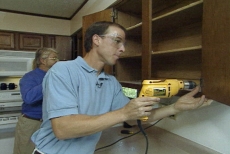
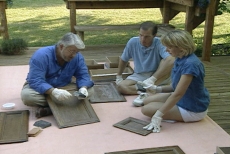
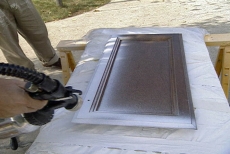
R. HAZELTON:  Ladies and gentlemen, start your drills.  Let's go, come on.  With all three of us using drills, fitted with screwdriver bits, the doors are off in a matter of minutes.  Okay.  Sabre, let's pull these drawers out here.  You and Scott, just grab them, pull them out, lift them up and pop them right out.  Great.  And stack them right over here, if you would, please.  Thank you very much.  Once the drawers are out, we remove all the hardware.  So these are cleaned.  We've gotten the hardware off.  Now we want to give these what's called a light scuff sanding.  And we don't have to remove all the finish on here, just roughen this up a little bit, so that the paint will have an easier time of gripping to this.  Now, we could sand using a medium grit sandpaper, say No. 80 or 100.  But today, I want to try out these sponge rubber sanding blocks, because I think they'll do a great job of getting up into the corners.  Next, we'll be using something called a tack cloth.  And these are, as you can see, really sticky pieces of cloth.  So what you have to do is just sort of wipe it, and you can see, that's all the stuff that was on the surface here that this is picking up.  To prime the doors and drawer fronts, we're going to use a very inexpensive, high volume, low pressure sprayer, like this one right here.  Very simple to use.  You just want to keep the nozzle of the spray gun about six or eight inches from the surface there.  I'll do one and give it to you guys.  We start by spraying the outside edges, making sure to keep the spray nozzle a constant distance from the surface.

SABRE HILL:  Oh, this is going on so easy.  I can do this.

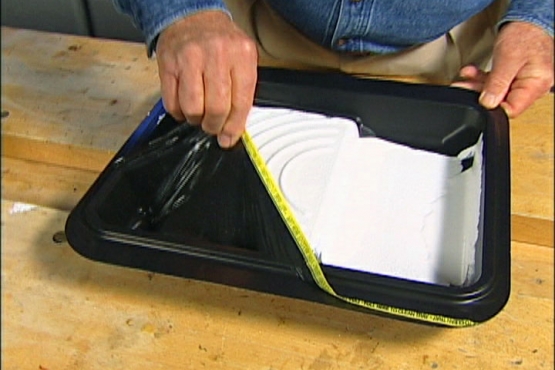
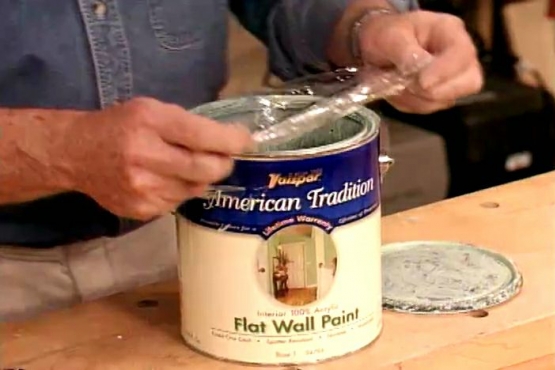
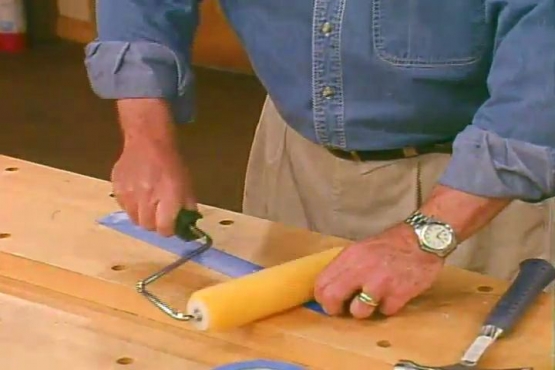
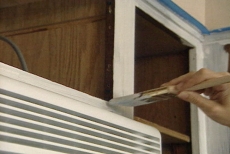
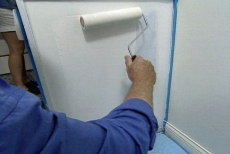
R. HAZELTON:  Next, the inside edges get painted.  The interior panels are sprayed last, working from bottom to top.  To keep from over spraying, I suggest that Sabre take her finger off the trigger momentarily, at the end of each stroke.  While the primer is drying, we go back inside to start work on the cabinets.  We begin by applying masking tape to cover the walls.  We could spray these cabinets, but if we do that, we've got to mask everything off right here.  I think it's a little bit more trouble than it's worth, okay?  So we're going to do this with brush and roller.  A two inch sash brush is used to prime the edges of the cabinets, where they meet the ceiling and walls.  And if you would, do the same thing on the other side.  The cabinet ends can be covered quickly, using a short nap three inch roller.  The roller is also used to apply paint to the cabinet fronts, or face frames as they're called.  Those nice straight strokes, top to bottom.  For hard to reach and tight areas, it's back to the brush.  But for covering ground quickly, it's the roller.  Once you've rolled a surface like this, come back and do what's called striking off.  And that means to take your roller, begin at the top, and go all the way to the bottom, one long stroke, like this.  This will take out any roller marks and leave you with a smooth, clean, professional looking surface.  Primer has dried, so it's time to put the top coat on.  We're going to use a special cabinet and vanity paint.  This one is by Valspar.  The difference is that this will resist the lanolin in your fingers, because you're going to be touching this a lot, when you're opening and closing the doors.  So guys, go ahead, put it on the same way you did before, with the primer.

SABRE HILL:  Okay.  

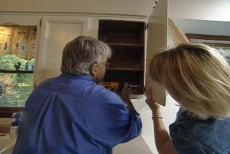
R. HAZELTON:  I'm going to use a slightly wider roller, to get these big end panels down here.  This will just save us a little bit of time.  Back outside, we start painting the doors and drawers, using the same specially formulated cabinet and vanity paint.  We thinned it slightly with water, so that it will flow easily through the spray gun and level properly.  The key here is put on enough paint to flow out evenly, but not so much that it will run or sag.  As we finish each door, we set it off to the side to dry.  Let's do another one.  The drawers are best sprayed by sitting them on end, so that the faces are horizontal.  Less chance of drips and runs this way.  After giving the paint 24 hours to dry, we install the new knobs.  Reattach the hinges, which we decided to repaint.  And begin replacing the doors.  There we go, Sabre.  Just, yeah, if you just hold that for me right there.  Good.

SABRE HILL:  Yeah, got it.

R. HAZELTON:  Okay.  Screws in here.  Finally, we reinstall the drawers.  In all, the project has taken us a day and a half.  Well, take a look for yourself.  In this short time, we transformed this kitchen into one that's bright and cherry.  I like this.

SABRE HILL:  Oh, the color.

R. HAZELTON:  What a difference, huh?

SABRE HILL:  The color is great.

R. HAZELTON:  Yeah, you happy?

SABRE HILL:  It's professional.  It's exactly what we wanted.

R. HAZELTON:  A couple of hours.

SCOTT HILL:  Yeah, it was great.

R. HAZELTON:  A couple gallons of paint.  Brand new kitchen.

SABRE HILL:  It worked great.

R. HAZELTON:  So you guys, you were terrific to work with.  I think we deserve a toast.  I think we got a little of this left over.  There you go.  This looks like to me, oh, Colonial Cream.  There we go.  Okay, guys.  To a great job and a great set of working partners.  Semi-gloss or flat?

How to Paint Existing Kitchen Cabinets Using a Low Pressure Spray System.

Bring new life to your existing kitchen cabinets with a fresh coat of paint. Save the time, expense and hassle of a full kitchen remodel and give your cooking and storage space a clean new feel. With a few tips about how to best prepare the surface, you'll be on your way to a kitchen that you are proud to entertain in.
Clean the Cabinets
Step 1

Clean the Cabinets

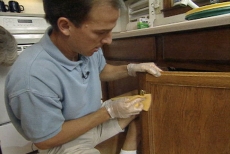
In order for the primer and paint to form a tight bond with the cabinet surface, you'll have to make sure that all existing grease and food residue is removed. Even the cleanest kitchen will build up a thin film of grease over time, so use TSP or a similar cleaner to gently wash all of the surfaces that are to be painted over.
Remove Doors, Drawers, and Hardware
Step 2

Remove Doors, Drawers, and Hardware

In order to have a paint job that looks professional, you'll need to take the time to compeletely remove all of the hardware. Don't skimp on this step just to save a little time. You will be much happier with the results when all of the hardware is crisp and clean against the newly painted cabinet doors and drawer faces. If you don't have a screw gun or drill, a simple screwdriver will suffice.
Lightly Sand the Flat Surfaces
Step 3

Lightly Sand the Flat Surfaces

Once the doors are clean and the hardware has been removed you will need to lightly sand the flat surfaces. Use a light sand paper, or better yet, a lightly grained sanding sponge to work the nooks and crannies of the doors. This light sanding pass will help create a porous surface for the the primer and paint to stick to. Once the sanding is done, use a tack cloth to wipe clean any loose dust that may remain.
Prime the Cabinet Doors with a Sprayer
Step 4

Prime the Cabinet Doors with a Sprayer

Using a high volume, low pressure sprayer is the easiest way to ensure a professional looking finish. Not only does this tool save time, but it minimizes the number of brush and roller strokes that you will have to contend with in your final project. When spraying, start on the outside edges of the doors, and work your way to the middle.
Prep and Prime the Wall and Base Units
Step 5

Prep and Prime the Wall and Base Units

Unless you want to go through the tedious task of masking off your entire kitchen, the base and wall cabinets will have to be primed and painted by hand. Make sure that you have a 2" sash brush and a small roller on hand so that you can create the high quality finish that you want. Start by taping any areas where you are concerned about errant brush strokes, and then apply an even coat of primer using the brush and the roller.
Apply the Topcoat
Step 6

Apply the Topcoat

For this project, Ron is using a specially formulated paint that resists the oil and dirt from people's fingers. This will help the durability of the paint, since on cabinets people touch them all of the time. Repeat the steps from priming the base and wall cabinets with the topcoat. When you are ready to spray the doors and drawer fronts outside, you may find it necessary to thin the topcoat slightly just to help it spray evenly. This can be done with water. Be careful to apply just the amount of paint necessary and not any extra. If you apply to much, it will run or sag.
Reinstall the Hardware and Doors
Step 7

Reinstall the Hardware and Doors

After the paint has had a chance to dry and harden completely (usually 24 hours or so) you can screw the hardware back into place. Just use the same holes that you took them out of originally so that they fit back into place quickly and easily. Slide the drawers back into their runners, taking care not to scratch the freshly painted face frames on the base cabinets.

18Project Comments

We welcome your ideas and suggestions. Read through comments from other readers or leave your own.

i have an earlex 5500 hvlp sprayer.  what kind of paint exactly did you use for the topcoat?  what stores carry it?  thx!

avatar
alf
May 3, at 11:06pm

I can not get you videos to play at home or on the computer at the library and yes I did ask for help. This has been going on for two weeks. What’s up?

avatar
james snook, jr.,
Mar 29, at 6:21pm

Thank you for the suggestions on renewing kitchen cabinets.  I have heard that adding a hardener to the paint will make the coat more durable to wear-and-tear especially around the door handles and pulls.  Can you explain how paint hardeners are used and if they will work in hvlp sprayers.

avatar
Michael
Mar 25, at 5:51pm

What kind of sprayer, and how to paint brass-finished hinges that are mounted on the face of the cabinets?

avatar
JOYCE
Mar 25, at 1:13pm

I would also like to know which brand of sprayer was used, and the process for painting the old hinges. As mine are bright brass-finished, old-fashioned offset hinges, with the cabinet portion screwed to the face of the cabinets, both the hinges and screw heads would need painting. Thanks for any information you could provide on this subject!

avatar
JOYCE
Mar 25, at 1:08pm

This is great, wish I knew it before I had someone else paint my cabinets, I don’t think they cleaned, nor sanded, nor primered before painting and they look awful.

Yes, please let us know the inexpensive hvlp sprayer you used.

Also, you glossed over painting the old hinges (I think you said), vs. replacing them, what was the procedure for that?

Thanks,

Rich

avatar
Rich
Mar 25, at 11:37am

Good stuff. This was going to be my next project. But my cabinets were painted years ago before we moved in. It looks as if a couple different colors were painted over. Can you guide me through the process on what to do?

avatar
Ron
Mar 25, at 10:56am

Ron, I have done this before , but one of the problems your viewers might have , is make sure you have a numbering system for your cabinet doors, especially when doing a lot of doors. Saves a lot of time when re installing the doors. Dallas Auld

avatar
Dallas Auld
Mar 25, at 9:31am

I recently painted my cabinets. A sprayer does the job faster than a roller brush, but if you don’t have a sprayer, use ultra-smooth sponge roller brush. This leaves much smoother finish look with no tracks or bubbles. A smooth roller brush leaves rough finish look.

avatar
david
Mar 25, at 9:04am

The way the kitchen cabinets were re painted was well and good except for one thing—-you did not paint the back side,  this is were you get in trouble with edge run over and sag—you need to show your method of doing the back side before the project is complete.

WoodWonders by Marx
[email protected]

avatar
Ed Marx
Mar 25, at 8:47am

Is the process the same for formica cabinets?  I really want to paint mine in the kitchen and bathroom.

avatar
Debbie
Mar 25, at 8:01am

Thanks for changing the format of your video clips. I can now view the great tips on my slow ADSL line

avatar
RobertKza
Mar 25, at 1:59am

We have been hearing on some of the current tv home repair shows that painted cabinets will always have paint chips…...if we follow your directions to the ‘t’.....clean them real good, sand and use a ‘tack cloth’ after sanding, 
Then, prime and paint, do you think they would ‘chip’ like the newbees are saying.  You have been doing this type of work longer than these newbees so I would much rather trust what you say.  Thank you for any help you can give us, we can sure use it.

avatar
Grannievee
Mar 4, at 10:47am

yes please did anyone ever find out which inexpensive hvlp sprayer ron used to spray the kitchen cabinets, thanks

avatar
petra
Jan 3, at 2:47pm

We are thinking of doing the same thing with our cabinets.  You mentioned a cheap dvlp sprayer but did not mention the brand name.  Could you provide that information or recommend other brands that would not be so expensive.  Thank you and look forward to tackling this project

avatar
jon
Nov 24, at 11:24am

I am thinking of doing the same thing with our old cabinets and have never used a hvlp spray paint gun before.  You mentioned a cheap one but did not provide the brand name.  Could you provide this brand name or recommend other types that would do a good job.  Thank you
Jon

avatar
jon
Nov 24, at 11:20am

Great segment.  Just what I was looking for.  We just renovated our kitchen after a water supply line took out our first floor.  I kept all the old wall cabinets to install in the garage for a work area.  I am getting ready to prep them and wanted to see the process before painting.  Great tips, this helped, the information regarding cleaning the cabinets first was something I hadn’t thought of.  I like the idea of the sponge sanders too as we have raised panel doors that I was trying to figure out how to scuff.

avatar
Glen
Sep 24, at 8:47pm

This is a great way to give your cabinets a makeover but, what i would like to know is will this work on cabinets in a manufactured home? also, is it ok to replace faux cabinet doors with real wood ones because, the ones i have puff after a while from getting wet.

avatar
Gloria
Sep 19, at 3:25pm

Submit A Comment

If you have a comment, question, or suggestion about this project, submit it here.

All Fields Are Required

Please enter the word you see in the image below: