How to Refinish a Kitchen Table

Video Transcript

Video Transcript

RON HAZELTON:
Today I'm answering an SOS from my neighbor Christine, who has given up on her kitchen table because she considers it well, beyond help. I'm going to have a look.

[DOORBELL]

Hey, good morning Christine.
CHRISTINE:
Hey, Ron, good to see you.
RON HAZELTON:
Hey, Oliver, how you doing buddy? So this is the table -
[BOTH SPEAK AT ONCE]
CHRISTINE:
This is it.
RON HAZELTON:
Oh, wow. This is the table that gets all the use, right?
CHRISTINE:
You bet, yeah.
RON HAZELTON:
Constantly, yeah. You know, what I think happened here is I think the original finish on here was on the thin side. And what's happened with all the cleaning and just time and plates being dragged across this, that finish has just plain worn off.

In fact, it's worn so much that even the color underneath the stain is gone in some places. So you're -- we're looking pretty much at bare wood right now. So what I want to do is, kind of take this back to how it looked when it was new.
CHRISTINE:
That would be great.
RON HAZELTON:
But the finish I'm going to put on here is going to be a lot tougher. It's going to hold up to the kind of use a kitchen table gets, all right.

CHRISTINE:
That's what we need.
RON HAZELTON:
Now this job is one I prefer to do in my shop. So I'm taking the top of the table back with me.
[MUSIC]
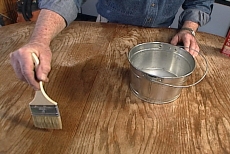
Now the first thing I'm going to want to do is remove what's left of this finish on here and I'll be using a paint stripper. This is a thick paste brushable type.

Okay, now I'm going to be applying this to the tabletop with a fairly wide, natural bristle disposable brush. Now the whole idea when I'm working with stripper here is I don't want to over brush it. I want just enough to spread this out, because the chemicals in the stripper that do the work, are gases.

And the more I brush this, the more they escape into the air, the less are left behind to do their job, which is to loosen the paint up. So just enough brushing to lay it on the surface like this.

Now the whole idea with stripper is to let the chemical do the work, so I want to give this just a few minutes. And if you look at the surface here, you'll begin to see that the finish is actually bubbling up. It's lifting itself from the wood underneath and that's what we want to be looking for.

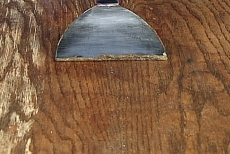
Now to lift that old finish off the surface, I'm going to use a wide putty knife. I'm going to make one modification to this tool first though and that is, I want to round off the corners here so that they wouldn't dig into the surface.

By holding the putty knife at a shallow angle and applying moderate pressure as I move across the surface, I can remove nearly all the old finish in one pass. A small box makes a good receptacle and gives me an easy way to clean my putty knife. I'm applying the stripper to smaller sections at a time to prevent it from drying out and allowing the finish to become hard again.
[MUSIC]
Now I've opened the shop doors and have plenty of cross ventilation while I use these chemicals.
[MUSIC]

Medium coarse steel wool does a good job of removing the old finish from the rounded table edge.

Now that paste stripper took off most of the finish. There's a little bit of residue here though, so I'm going to go over it a second time, only this time I'm going to be using a liquid stripper. I apply the liquid stripper liberally with a brush.

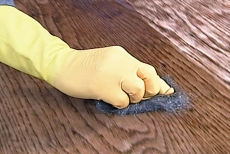
It flows into the wood grain loosening the old finish there and softens anything left behind by the paste. Medium fine steel wool helps dislodge any stubborn remnants and lift them from the surface. To prevent scratches, it's important to make long straight passes in the direction of the wood grain.

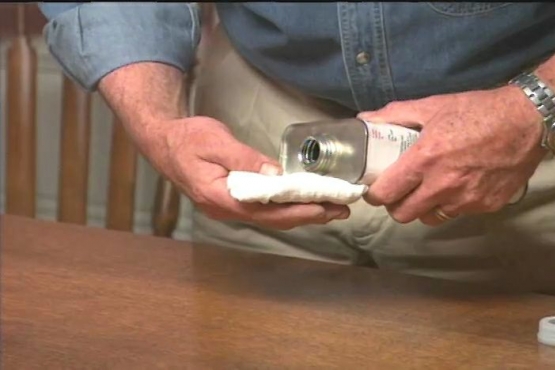
Well, I'd say all of that finish is off but I am going to go one more step here. I don't always do this, but most of the time I like to. These strippers have waxes in them and this last step is a wash with lacquer thinner and the idea here is to wash off any of that wax that's been left behind.

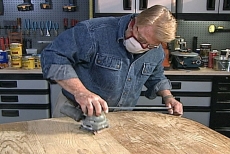
Again, I brush on the lacquer thinner, then use fine steel wool for this final cleaning. Now it's time for a little sanding and I do mean little. This tabletop is oak veneer, probably only a 16th of an inch thick, or less.

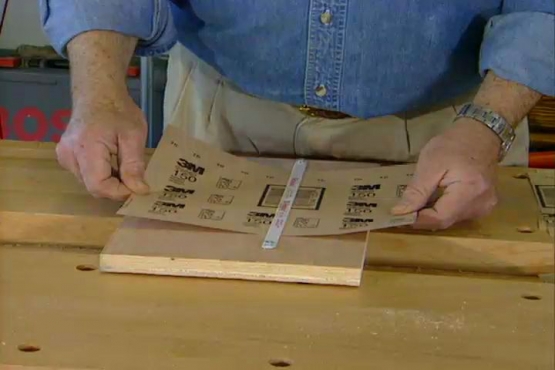
I'm using a finishing sander with 220 grit sandpaper.
[MUSIC]

Well, the table is stripped, sanded and cleaned. Now it's time to put some color back, or stain it. Now remember, I'm only doing the top of this table, so I've got to get this color to be a pretty close match to the base.

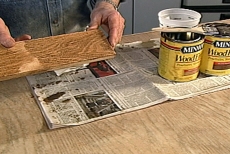
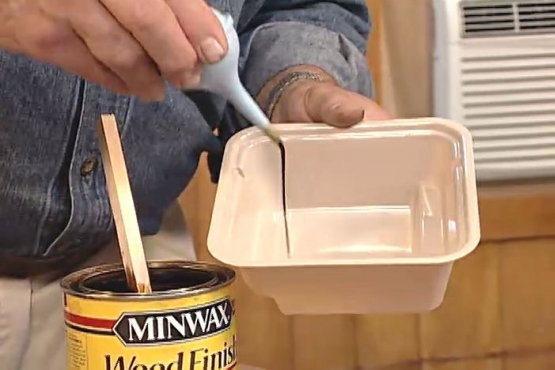
What I've done is taken a couple of colors here, Special Walnut and Ipswich Pine and I've put samples of each on this board right here. Well, let's see how this looks. I'd say the Special Walnut right here is a little bit dark and the Ipswich Pine might be just a shade light, but I bet if I inter-mix these two, I'd get pretty close.

The Special Walnut will be my base color. To lighten it just a bit, I'm using a baby syringe to add a small amount of the pine stain. Now you can apply stain with a rag or a brush. I kind of prefer a brush. I like to put it on fairly wet and then wipe it off with a cloth or a paper towel.
[MUSIC]
Here too, I work in the same direction as the grain, wiping in long, even, straight strokes. Well, the color’s restored. I'm going to let this dry now for at least 24 hours and then I'll come back and put a clear top coat on.
You know, in just about any refinishing or painting job, preparation is the most important part of the project and I think we've done a pretty good job of preparing this here. It looks fantastic. Now I'm about ready to start putting on the -- the clear top coating.

This is polyurethane. And you notice that I'm stirring it here. You may wonder well, why is he stirring it, it's a clear material? Well, this is actually a semi-gloss polyurethane and the reason I'm stirring it is that the flattening agent can settle to the bottom of the can.

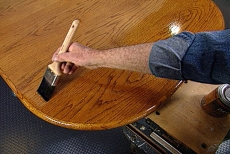
So what I want to do is pick it up and redistribute it throughout the liquid here. I give the table a final dusting to remove anything that might have settled onto the surface. Now this is an oil based material, so I'm going to be using a natural bristle brush, and you know, I don't skimp on my brushes on a job like this. I want to make sure that I'm using the best brush I can find for a couple of reasons. It's going to lay a much smoother finish and the likelihood of me dropping bristles out leaving them in the coating, is going to be very small.

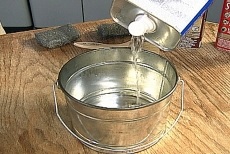
Rather than work directly from the can, I like to pour the finish into a clean container. Then load the brush by dipping it in and gently slapping it on the sides to remove any excess material. I'm using a satin, polyurethane that will enhance the wood grain, give a soft sheen and most importantly, provide a tough, durable surface that will stand up to spilled liquids and scuffing.

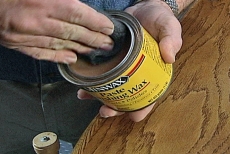
In this case, I'll apply three coats and sand lightly in between. The final coat is thoroughly dry and I'm now applying paste finishing wax with a pad of 4-O steel wool. Now doing this eliminates any minor surface imperfections and gives the tabletop a smooth, almost velvety feel. I let the wax dry for a few minutes, then buff it with a soft cloth.
[MUSIC]
Well, it's time to put this piece of furniture back into service.

Ready, one, two, three.
CHRISTINE:
Wow [LAUGHS]. It's like a new table.
RON HAZELTON:
Turned out nice, didn't it?
CHRISTINE:
It's gorgeous.
RON HAZELTON:
Now it, it actually is, is in a way, better than a new table because the finish that I've put on here is really tough, okay.
CHRISTINE:
It has to be. Okay, nobody can eat on this.
RON HAZELTON:
Like it? No, no, no -- I want to show you something, okay? I've got three coats of polyurethane on here. It will take just about anything. And so to demonstrate, watch this.
CHRISTINE:
Watch, Oliver. Wow.
RON HAZELTON:
You see how that water beads completely up on the surface. So any kind of spill like that, you just take a cloth --
CHRISTINE:
Watch.
RON HAZELTON:
And wipe it up. I put a coat of wax on here. Maybe like twice a year, I'll give you some --you know, put a little more wax on it.
CHRISTINE:
Okay.
RON HAZELTON:
And that's really all you're going to have to do to care for this. It's really -- so use it – what I’m saying is it looks nice, it's pretty, but use it.
[BOTH SPEAK AT ONCE]
CHRISTINE:
Well, you can’t have milk without brownies, made these fresh for you this morning.

RON HAZELTON:
Oooeee, hey, you know, what?
CHRISTINE:
Thank you for my new table.
RON HAZELTON:
You're very welcome. I'll do a table any time for fresh brownies.
CHRISTINE:
That's a deal.
RON HAZELTON:
You have one?
CHRISTINE:
That's a deal.
RON HAZELTON:
Oh --
CHRISTINE:
Oh --
RON HAZELTON:
Oh, you know, but from now on, you won't have to cry over spilled milk.

Sometimes we can really be surprised at the beauty that's lying just beneath the surface. That's certainly the case here.

Strip, Stain and Recoat Your Old Wooden Table Top to Restore the Scarred Oak Veneer to a Beautiful New Finish

Refinish an oak veneer table top that is scuffed and faded by years of kitchen use. Detach the table top and relocate to a ventilated workshop to minimize fumes and dust. Remove the old finish, sand and stain, and then coat the surface with several coats of durable water-proof clear coat before reenlisting the table as kitchen furniture.

Detach and Move the Table Top to a Ventilated Workshop
Step 1

Detach and Move the Table Top to a Ventilated Workshop

Examine the wooden table to confirm that the table top alone needs refinishing. Remove the top from the frame. Protect it while moving it to a well-ventilated work area to avoid chemical fumes and dust inside your home.

Brush on Thick Paste Finish Remover, Letting the Chemical Work
Step 2

Brush on Thick Paste Finish Remover, Letting the Chemical Work

Apply a thick paste remover with a disposable nature bristle brush to a small area. Overworking stripper lessens its effectiveness, so use minimal brushstrokes. Give the gases in the chemicals time to bubble and lift the old finish.

Use a Wide Putty Knife and Scrape off the Finish
Step 3

Use a Wide Putty Knife and Scrape off the Finish

File the sharp corners of a wide putty knife and gently scrape up the wet residual finish lifted by the stripper. Clean the putty knife on the edge of a small cardboard box lined with newspaper. Work with the grain.

Apply Liquid Stripper and Use Steel Wool to Lift Remnants
Step 4

Apply Liquid Stripper and Use Steel Wool to Lift Remnants

Brush on liquid stripper and let it work. Use medium fine steel wool to dislodge remnants left by the paste. Work the rounded edges of the table top with steel wool to clean the surface. Work with the grain.

Wash Away Waxy Stripper Residue with Lacquer Thinner
Step 5

Wash Away Waxy Stripper Residue with Lacquer Thinner

Dip medium fine steel wool into lacquer thinner and work with the grain to wash away the wax-like residue left by the strippers.

Use a Finishing Sander to Smooth the Surface
Step 6

Use a Finishing Sander to Smooth the Surface

Wear a face mask while you smooth the oak veneer using 220-grit sandpaper and a finishing sander. Keep working with the grain and don't over-sand, because the veneer is very thin. Clean away the sanding debris.

Apply Matching Stain, Letting It Dry for 24 Hours
Step 7

Apply Matching Stain, Letting It Dry for 24 Hours

Match existing color, mixing stains if necessary and testing on scrap wood. Coat the table top with a brush or rag. Wipe off the excess with a lint-free rag and let it dry for at least 24 hours.

Bush on Three Coats of Semi-gloss Polyurethane Clear Coat
Step 8

Bush on Three Coats of Semi-gloss Polyurethane Clear Coat

Stir the semi-gloss clear coat thoroughly to mix the flattening agent. Apply the clear coat with a good quality natural-bristle brush to avoid dropped bristles and produce a smooth coat. Sand and clean between each coat after they dry.

Apply Finishing Wax with Super Fine (#0000) Steel Wool
Step 9

Apply Finishing Wax with Super Fine (#0000) Steel Wool

Rub finishing wax on the dried surfaces with super fine steel wool to eliminate any tiny surface imperfections and give them a velvety finish. Let the wax dry for a few minutes, and then buff it with a soft cloth.

31Project Comments

We welcome your ideas and suggestions. Read through comments from other readers or leave your own.

Thanks so much for video. I have been looking for something to help me re finish my table. I have one question, I was just wondering on table legs and things that have a lot of detail work that are not very smooth, how do you go about sanding and stripping that?

avatar
Krissy
Apr 4, at 4:55pm

Ron,

Thanks for this walk through.  I am in the process of staining my kitchen table to a different color entirely!  By using your suggestions, things are going nicely & I am on the last chair before I clean and start applying the stain! I cant wait to see the final product!

avatar
Ginny
Mar 24, at 7:39pm

Great video!
My oak table is 20 years old.  Parts of the table are very sticky.  Is that is finish that has been coming off?
Is there any other thing I can do besides refinishing? Just curious.
Thanks

avatar
Chris
Mar 21, at 8:20pm

THANK YOU. That looks exactly like our table. I have never done a project like this and now I know how.

avatar
Gil
Mar 12, at 8:01pm

I always had a problem getting a smooth finish on flat surfaces until I tried your steelwool and pastwax method.  This works great. I have showed my other woodworking friends and they couldn’t believe the outcome. Ron thanks for this great tip. I have used this on two tables and a chair already.

avatar
John LeSage
Mar 10, at 8:21am

Really helpful! Thank you!

avatar
Sharon
Mar 2, at 9:19am

The video has really enthused me.  I am ready to redo my Drexel tabletop. The only problem is matching the stain color.  It seems to be a pecan color. I am glad you showed how to add a color to the main stain.

avatar
susan irving
Feb 12, at 11:35am

Excelente trabajo Ron muchas gracias.

avatar
Juan Contreras Carvajal
Feb 6, at 8:02am

Ron,
I just refinished my 20 year old solid oak (no veneer) kitchen table top.  It was in about the same condition as the one in your video. It looked terrible!  I contemplated getting a new table until I saw this video.  I followed your step by step instructions and I am amazed with the results.  The table top looks better than the day I bought it.  I am pretty handy and have worked with polyurethane quite a bit but I never knew about the finishing wax and steel wool.  It gave the final coat the factor finish that a kitchen table needs.  Awesome project!

avatar
Tom D
Jan 29, at 10:51am

Ron,
I just refinished my 20 year old solid oak (no veneer) kitchen table top.  It was in about the same condition as the one in your video. It looked terrible!  I contemplated getting a new table until I saw this video.  I followed your step by step instructions and I am amazed with the results.  The table top looks better than the day I bought it.  I am pretty handy and have worked with polyurethane quite a bit but I never knew about the finishing wax and steel wool.  It gave the final coat the factor finish that a kitchen table needs.  Awesome project!

avatar
Tom D
Jan 28, at 5:43pm

Great video which makes it seem fairly easy. I do have a question however regarding the polyurethane. Did you use semi-gloss or satin on this project?  When you were stirring the clear coat poly in the can you said that it was a semi-gloss that you were using, but when you began to apply the finish you said it was a satin finish. I liked the finished results of the table and would like to use the same finish.  Also, you said that you lightly sanded between the three coats of poly but the video didn’t show what you sanded with.  Steel wool or sand paper? Thanks

avatar
Jerry Alvarez
Jan 27, at 5:07pm

Great video which makes it seem fairly easy. I do have a question however regarding the polyurethane. Did you use semi-gloss or satin?  When you were stirring the clear coat in the can you said that it was a semi-gloss that you were using but when you began to apply the finish you said it was a satin finish. I liked the finished results of the table and would like to use the same finish.  Also, you said that you lightly sanded between the three coats of poly but the video didn’t show what you sanded with.  Steel wool or sand paper? Thanks


avatar
Jerry Alvarez
Jan 27, at 5:02pm

Great job Ron ,I’m going to follow this same method to refinish a table for a friend
This is the best video I’ve seen, you know what your doing.
                                                          Thank for this video
                                                            Gilles

avatar
Gilles Bonneteau
Jan 23, at 1:23am

Ron
At the Home depot store ,there is a product that you mix for tables like you would see in a restaurants mixing resin with a hardener 50%/ 50% mix .I was going to granite my counter top in kitchen , I was wondering if this product could be use to cover the formica counter top with the back splash .Iknow it is tricky ..Iwas wondering if you could contact the supplier and see if they could show me or use the trick on using this product it is expense and approx $25. per 9 square feet which is much cheap than a granite counter top and high gloss looks great and it seems like it is hard as a rock,, any suggestions ...p.s. love the show keep up the great work for passing along the knowledge for us home repair men thank steve

avatar
Steve Di Sano
Jan 21, at 8:01am

I conditioned, stained, this went well. Applying the varnish/poly, first coat 24hrs to dry, sand with 220 then 600/lemon oil and cleaned with spirits, second coat the same way, third coat applied like the first two with a good pure bristle brush.
The final finish came out with little dust particals and what looks to be air bubbles. I have a nice new 20 x 28 shop to work in and I did my best to ensure it was dust free. Unfortunately I don’t have a paint booth and exhauste fan.
I have re-sanded and started over a couple of times with the same results.
What I’m I doing wrong.
On an existing piece, if I use Furniture Refinisher, will it remover the stain?

avatar
Bob
Jan 20, at 9:45pm

Thanks Sir,
This tips is very useful for my work

Regards
Kuldeep

avatar
kuldeep
Jan 9, at 10:33am

Great procedure Ron. I tried it on Friends night stand. Looks like new.Thanks

avatar
Kevin Cox
Dec 24, at 8:12am

I have a square table with a very thin(I mean very thin) veneer on top. Almost paper thin. There are many chips in it. Cover up stain pens don’t cover the chips. What can I do to fix the problem?

avatar
Paul C
Dec 4, at 10:27pm

Hi we are trying to refinish our maple table that is about 50 years old we are at the final stages and the 2nd layer of top coat has developed some bubbles any suggestions on what to do and to keep it from happening with the 3rd and possably fourth coat.

avatar
misty
Nov 17, at 5:08pm

Great Video, We just had our Oak Table Refinished and concerned about the Oak Grains not being filled in. The openings or grains make the table look nice but as a Kitchen table im worried about dirt and water getting into them.

Should a Oak Table top have a thick finish with no grains?

avatar
Kevin
Nov 10, at 11:28am

You mentioned that the table top was veneer so I have a comment/question regarding veneer.
Our kitchen cabinets are for the most part solid birch but the end of the cabinets are covered in veneer. I have read that using stripper solutions can sometimes have an effect on the glue holding the veneer to what ever is underneath. Thus making the veneer come unglued and peel away. I would like to strip all the cabinets and stain them a little darker. I have tried sanding the inside of one of the cabinet doors but there is a thick layer of sealer and it would take forever. I would use a stripper but am afraid I would ruin the veneer and then get in over my head and budget. Any suggestions? We have a lot of cabinets! To costly to replace them all.

Thanks,
Chris

avatar
Chris
Nov 2, at 12:46pm

My table about 5years old. I would like refinesh it do I have strip it I want to keep the same color

avatar
Abraham Peters
Oct 29, at 1:12pm

Great video.  Very informative but the milk spill at the end was corny:)

avatar
sean
Oct 11, at 3:31pm

I’d like to refinish my coffee table, but there is a black line all around a few inches from the edge and I think it will be removed if I use the finish remover.

avatar
susan
Sep 28, at 4:13pm

I refinished my 14 year old kitchen table top, and it looks amazing. Thanks for the easy to follow video. I saved hundreds of dollars. On to more projects.

avatar
Susan
Sep 28, at 4:10pm

I would say the best part of this video is when Ron reaches for the milk, but quickly diverts to the brownie and knocks over the cup.

avatar
Todd Heifner
Sep 25, at 11:39am

GREAT DEMO , LAYING A NEW FLOOR IN THE KITCHEN AND NOW I CAN DO THE KITCHEN TABLE. YOUR WEB SITE IS GREAT. KEEP UP THE GOOD WORK

avatar
LARRY W SKILLETT
Sep 16, at 10:36am

Hi Ron, Great demo! One thing confuses me. In between coats of laquer, you say to sand lightly. Is this to roughen up the undercoat? How then do you get a smooth finish? My table is round. Any suggestions?

avatar
Heather Burton
Sep 10, at 7:25pm

Great demo! It gave me a good understanding of what needs to happen.  I could not find the liquid stripper you demonstrate but there was a Wash that I used that actually did the job.  The demonstration was enough to actually coach me through my own project.  Thank you!

avatar
Ron Poulin
Sep 6, at 4:23pm

I am wanting to sand in lieu of paint remover.  How do you tell when you a hit the sweet spot ?

avatar
louis C
Sep 5, at 12:13pm

Thanks!  That was fabulous.  I’m in the middle of a project and beginning to panic (because of instructions for toxicity). 

Your demonstration calmed me down.  I think I can do it.  Do you have any Briwax instructions, and how do you keep your sanding bag clean?  Do you wash it with water?

avatar
Barbara W
Aug 29, at 2:09pm

Submit A Comment

If you have a comment, question, or suggestion about this project, submit it here.

All Fields Are Required

Please enter the word you see in the image below: